Friday, January 9th, 2026 09:01 am
You probably don't much like thinking about death. It's understandable: death is sad and scary, and few of us look forward to it coming for us or anybody we love. But believe it or not, reminders of death have not infrequently been baked in as a cultural practice -- in a couple of cases I'm going to discuss, literally baked!

There's a grim reason for this, which is that death was far more of a looming threat for historical people than it is for us. Obviously it's true now, as it was then, that everybody eventually dies; the difference is that the average person today can expect to enjoy decades of life first. But life expectancies in the past were much lower -- which is not the same thing as saying that most adults died by the age of thirty! The reason average life expectancy was so much lower is that the odds of surviving your first few years were horrifyingly low. Childhood diseases like the measles tended to kill almost half of all children born before they reached the age of ten.

Which means that nearly every family in existence, rich as well as poor, suffered the repeated grief of seeing life cut short before it really had a chance to start. Then, for those who made it to adulthood, men often had a meaningful chance of dying in war, and women faced the recurrent risk of dying in childbirth. On top of all that, there's the experience of death: people were more likely to die at home, rather than off in some hospital, and ordinary people had the task of caring for them in their final hours and preparing their bodies for funerary rites afterwards. They saw and touched and smelled the effects of death, in a way that most of us today do not.

One of the ways to cope with this is to look death squarely in the eye, rather than flinching away. The Latin phrase memento mori, an exhortation to remember that you must inevitably die, has come to signify all kinds of cultural traditions intended to remind people of the end. Our modern Halloween skeletons and ghosts used to have that function, even if few of us think of them that way anymore; let's take a look at some other approaches.

A few memento mori traditions are things you do rather than objects in your life. Buddhism, for example, has traditions of "foulness meditation," in which a person is encouraged to contemplate topics like disease and decay -- sometimes in cemeteries or the presence of corpses. After all, Buddhism tells us the nature of the world is impermanence, and what illustrates that more vividly than death? Islamic scriptures likewise exhort believers to think about death, and some Sufis make a habit of visiting graveyards for that purpose. I'm also reminded of a fictional practice, which I think might be based on something in the real world, though I can't place it: in Geraldine Harris' Seven Citadels quartet of novels, the Queen of Seld holds banquets in what will eventually be her tomb.

Speaking of banqueting, the Romans had a rich tradition of memento mori (as you might expect, given that we got the phrase from their language). In the early imperial period, it was fashionable to dine in rooms frescoed with images of skeletons and drink from cups decorated with skulls. The message, though, was far from Buddhism's reminder not to become attached to impermanent things: instead it was, as the poet Horace wrote in that same era, carpe diem. Eat, drink, and be merry, for tomorrow you may die. These macabre decorations were meant to heighten the transient pleasures of life.

Other classical thinkers took it in a more Buddhist-style direction, though. Stoic philosophy is full of injunctions to curb the pleasures of life because you and all the people around you are mortal, and there are accounts which claim a Roman general celebrating a triumph was accompanied by someone reminding him that eventually he would die. We find the same sentiment echoed in the Icelandic Hávamál, with its "Cattle die, / kinsmen die, / all men are mortal" -- though that one goes on to praise the immortality of a good reputation.

Christian tradition leaned heavily into this for centuries, because of the theological emphasis on the dangers of sin and of dying unshriven. To have any hope of heaven, a Christian was supposed to live with one eye on the ever-present possibility of death, rather than assuming it must be far off and you'd see it coming, with time to prepare. Memento mori took every shape from tomb decorations (don't forget that many wealthy people were buried inside churches) to clocks (time is inexorably ticking away) to paintings (the genre known as vanitas emphasizes the vanity, i.e. worthlessness, of impermanent things) to jewelry. The devastation of the Black Death undoubtedly bolstered this tradition, as seen in the Danse Macabre artistic motif, where the Grim Reaper summons away people from all walks of life, kings and bishops alongside peasants.

I promised you baked goods, though, didn't I? Malta celebrates the Month of the Dead in November and commemorates the season with ghadam tal-mejtin, "dead men's bones," a type of cookie filled with sweet, spiced almond dough. And in Sweden, there was a nineteenth-century tradition of funerary confectionery, wrapped in paper printed with memento mori images -- though the candies were often meant to be saved instead of eaten, and some manufacturers bulked them out with substances like chalk to cut costs. You could break a tooth trying to bite into one.

We might even count death omens as a type of memento mori. Most of the ones I know about are European, and take forms ranging from spectral voices in the night to black dogs to a double of the person who's about to die -- with a certain amount of ambiguity around whether encountering such a thing causes you to die (perhaps with some way to avert it), or whether it's merely a signal that death is at hand. To these we might add plague omens, which I know of from both Slavic lands and Japan: people or creatures who appear to warn a town that an epidemic is about to sweep through. The Japanese ones usually promise that anyone who hangs up an image of the creature will be protected from disease, which is certainly helpful of them! (And yes, there was a resurgence in that tradition when the Covid-19 pandemic began.)

These days we are more likely to enjoy death imagery as an aesthetic rather than a philosophical practice. Our life expectancy is vastly higher -- in part because we're far more likely to survive childhood -- and thanks to modern medicine, even an ultimately fatal injury or illness stands a higher chance of giving us time to prepare for the end. But notwithstanding the fever dreams of some technophiles, we have yet to defeat death; immortality remains out of reach. Until that changes, mortality will remain an inescapable fact for every human born.

Patreon banner saying "This post is brought to you by my imaginative backers at Patreon. To join their ranks, click here!"

(originally posted at Swan Tower: https://is.gd/JVBlEI)
Friday, January 9th, 2026 02:55 am


"No!" Yelled Gideon. "Throw it at Daddy!"
Original is here on Pixelfed.scot.

Friday, January 9th, 2026 02:55 am


Intrepid explorers off to school.
Original is here on Pixelfed.scot.

Friday, January 9th, 2026 08:40 am
To enjoy a little society

How very charming, Caroline Kirkstall thought, was Lady Bexbury’s little place in Shropshire! The term ‘hunting-box’ gave one an entirely misleading impression – no doubt had been that when she had inherited from her late husband, but one might see that it had been refurbished by the hand of a lady with the most exquisite taste. O, nothing excessive – quite suited for country living – proper to its purpose as a rural retreat – but one wondered whether 'twould be encroaching to enquire of Her Ladyship whether she had any hints in the matter of decoration.

Supposing, Caroline pondered, that she returned to Mr Brackley’s house and did it up – for now she had ventured so far as to travel to London, and now made this solitary sojourn, she took the thought that she did not have to remain in Droitwich and feel that she was being gossiped upon, and speculations made &C. She was still by no means old, even did she not have such adventurous plans as that Lady Fendersham Lady Bexbury had mentioned, that went a daring voyage to Peru, where her son, that was in the Consular Service, had lately married.

But she might recruit here, in the very pleasant and healthful airs. And to her relief, Merrow was very prepossessed – the two women, Eppie and Dorrie, that looked after the place, might, she conceded, be somewhat countrified, but they kept everything entire spick and span and one could not fault their cooking! The steward, Raggle, most respectful – indeed, Miss Merrow might help herself to anything she fancied from the herb-garden. The countryside very pretty – one was a deal less worried among sheep than cows, was one not? The village a very fine tidy place, better shops than one would have anticipated –

That was reassuring! And also reassuring was the report that Merrow brought back of the local doctor, a Mr Randall – may not be one of your haughty fine physicians but is give out exceeding competent – the cottage hospital quite a model

Caroline had no particular troubles of health – otherwise she would have took the opportunity of being in Town to consult some leading physician – dared say – well, perhaps not Lord Peregrine himself, but his sister Lady Lucretia or her husband, or indeed the ladies at Mrs Mitchell’s – would have had recommendations – but it was comforting to know that there was a good medical man in the vicinity.

Shops – a small circulating library and reading-room – a school – besides the parish church also a Methodist congregation –

A certain number of what one must consider the better class – besides the doctor, and the parson and the minister, there were the manager of the mine and various others connected with the operation that were of a genteel sort –

And this very day, she found, certain wives had come to leave cards!

Fie, she said to Eppie, that brought them in, do you invite 'em in and we may have tea, and I fancy you can contrive something to’t –

Eppie grinned and said, that we can!

So came in Mrs Marston, whose husband was the manager of the mine, and Mrs Randall, that was the doctor’s wife, and Mrs Parfitt, whose husband was in charge of the smelting-works, and Mrs Carling, that was the parsoness – quite a young woman that Caroline fancied had not been in the place long.

They made very proper condolences upon Miss Kirkstall’s bereavement – my brother-in-law – went with my sister when she married him, to assist in housekeeping – tended her during her illness – remained to support him in his loss – no, they had not been blessed, alas –

Very proper and dutiful, remarked Mrs Marston. There were no prying questions such as Caroline had feared, and she waved them into the parlour chairs.

Mrs Randall advized Mrs Carling not to endeavour to disturb the elderly tomcat Portly that slumbered in a comfortable chair – o, he is quite the local character! Has a deal of temperament but quite the finest mouser are you ever troubled in that way – quite the haughtiest of felines –

Caroline could not help laughing, for that was entirely how they had found him. Not at all a cat to come make obsequious and purring but very much on his dignity. Might in time condescend to come sit upon a lap.

Whereas the little black spaniel Wowzkie was everybody’s friend!

Came in Eppie with the good tea service, and –

Ah, said Mrs Parfitt, I always say, the kitchen here has quite the finest hand with lardy-cake!

One might see Wowzkie look up with a pathetic expression of a poor little doggie that was being entirely starved, an impression quite belied by the sleek well-filled-out coat.

So they sat and drank tea, and eat the good lardy-cake, and what the ladies were most eager to know was did Miss Kirkstall have news of Lady Bexbury?

So she was obliged to say that alas, had seen very little of that remarkable lady – had met her while making a condolence call on Lord Peregrine Shallock at the home of his sister, Lady Lucretia Grigson – Mr Brackley having been his godfather –

This most greatly impressed the ladies and they desired to know somewhat of Lady Lucretia’s house – o, Belgravia? one hears 'tis very fine –

Gave something of a false impression of her Society connexions!

She turned the conversation to enquire about matters in the locality, that sounded to be in a very good way.

The ladies, minding that 'twas a first call, soon rose. In the process of taking their leave, Mrs Marston said that a quiet dinner party could not be improper in Miss Kirkstall’s situation, could it?

While Caroline did not have any authority to consult on the matter beyond her own conscience, she fancied that Nehemiah Brackley would have exhorted her to enjoy a little society, and said that she could not see the least objection, 'twas a very pleasing thought.

Indeed, Merrow was exceedingly gratified at the prospect. Furbished up Caroline’s best mourning wear in the style that had been conveyed to her by that finest arbiter, Miss Coggin of Mamzelle Bridgette.

Will entirely do you good, miss, to get out a little.

So she desired Raggle to put the pony to the gig, and confided that she might manage to drive down to the Marstons’ house herself.

A very eligible residence! Well away from the smoke and fume of the smelting works – that was a fine tall chimney to bear those away, and she dared say thought had also been took for the prevailing winds. Everyone most civilly welcoming – the Marstons, the Randalls, the Carlings, and o, here was a single gentleman, a Mr McAllan that was the chief engineer about the place, that they praised as a most ingenious fellow – would not know how they would get on without him – entire virtuoso in the matter of steam-pumps, had fellows come visit to see theirs –

A Scotsman in early middle age or so, that looked a little melancholy, but made very agreeable to her. Apologized that they had no fine sights to show her other than steam-pumps, to which she responded that the countryside hereabouts was very pretty, but perchance did not compare with his native soil?

Gave a gruff laugh and said that Glasgow in these bustling days was very unlike anything in the works of Scott! but a fine city, nonetheless.

The whole evening most exceeding agreeable – further invitations to come view the hospital – visit the school – take tea at the parsonage – &C&C.

It gave her to wonder whether 'twould be proper to make some return of hospitality, but while she was still musing upon this, a letter arrived under the Bexbury seal, that announced that sure it was very tiresome, and she was put about at having to intrude upon Miss Kirkstall’s solitary retreat, but Her Ladyship was obliged to come look over certain matters at the mine, and thus would be taking up residence for a few days.

Why, thought Caroline, nothing could be more delightful. One supposed that Lady Bexbury would be much took up with the cares of business – for she had been give to understand that she had a very sound comprehension of such matters, not one of your owners that sits in Town and draws dividends, appreciated the importance of investing in machinery &C – but it would be agreeable just to look upon her, quite a refreshment to the spirits.

So here she came, with her black maid Sophy, that Raggle was almost falling over his feet to assist in the disposition of the trunks, and with Leda Hacker, that 'twas very pleasing to see once more. And appeared on excellent terms with Eppie and Dorrie, making jokes about sheep in the kitchen – la, when first I came here they was raising orphaned lambs there –

Enquired whether Caroline had noticed any election turmoil hereabouts? There must be some hereabouts eligible to vote for the county members!

Few enough, remarked Lady Bexbury over her shoulder, that I doubt any agents will consider it worth their time to come canvassing. Cannot recollect any uproar on previous occasions. She sighed. I fancy 'twill be entire different at Tapperbridge –

She turned around. The Mulcasters are old friends, and have invited me to Qualling, she continued. Tapperbridge used to be a sleepy country town, not quite what they called a pocket borough, but they would vote as they thought the Duke would like. But since the coming of the railway has become a very different place.

Sophy came pattering down the stairs, crying that there was hot water brought and Her Ladyship should come and be repaired from the journey.

Merrow soon came on terms of the greatest admiration for Sophy – married to Jupp of the carriage-hire business, but they have the greatest loyalty to Her Ladyship for her immense kindness in the past, would not go sit at home as she could when she might be of service – not in the least haughty – has give me most helpful advice –

Had also, over gathering herbs from the plot in the garden, disclosed that Mr McAllan was a widower, o, a very sad tale – had married a young lady from Glasgow – very happy – then she and the baby died – everyone at the mine wishes he would wed again – not only has a fine salary, holds several remunerative patents –

La, Merrow, said Caroline, blushing, as she was having her hair dressed in this new way suggested by Sophy, do you go match-make?


Thursday, January 8th, 2026 07:14 pm
Challenge #2: Pets of Fandom

Loosely defined! Post about your pets, pets from your canon, anything you want!


Cat in my icon: Nyara. Dead since 2011, she was my first cat as an adult. I attribute the Death Of A Modem to her - the modem she's resting on in the icon, which she insisted on sleeping on because it was warm and I think it just got smothered in the end.

Named for the Changechild character in Mercedes Lackey's Winds series of Valdemar, she was stand-offish when it came to pats, but snuggly when it came to snoozing in bed next to me.

About a year after she died, I got Maladicta and Smokey.

cats and chooks )

--

Daniel the lemming )
Thursday, January 8th, 2026 08:59 pm
It is David Bowie's birthday, so I've been listening to Bowie today. But since yesterday I haven't been able to stop thinking of Phil Ochs's "I Kill Therefore I Am," especially these lines:

"Farewell to the gangsters
We don't need them anymore
We've got the police force
They're the ones who break the law
He's got a gun and he's a hater
He shoots first, he shoots later

I am the masculine American man
I kill therefore I am"
Tags:
Thursday, January 8th, 2026 08:21 pm
I've finished the introduction of Emily Mendenhall's Invisible Illness: A History, from Hysteria to Long Covid (UC Press, 2026). Mendenhall is a medical anthropologist; this is a research-informed narrative, not an individual memoir.

Since I'm all done with being a pseudo-reviewer, this post occurs before I finish reading Mendenhall's book, deliberately. Instead, here's Kirkus, and an excerpt.
Tags:
Thursday, January 8th, 2026 08:02 pm
Periodically I pick a series on Netflix to...not exactly "binge" which implies large volumes in a short period, but to use as my default background while doing evening things. Murder mystery series tend to be my preference. (Other types of series I tend to play more attention to.)

So currently I'm watching The Closer, a police procedural centering around an eccentric deputy chief of a murder investigations unit, starring Kyra Sedgwick.

Now, to be sure, this show is copaganda because you're invited to see the cops as the heroes (by virtue of being the central characters). But it undermines the copaganda angle on a regular basis, by highlighting the unbelievable volume of lies and intimidation used by the police. (The central character is even overtly depicted as a compulsive liar who misdirects even her family and love interest in order to avoid confrontation and dodge responsibility.) But there are occasional episodes where the show solidly critiques when cops go "beyond the line," while still allowing their tactics to be effective.

Kyra Sedgwick's character is also clearly depicted as having ADHD, which interacts toxically with her workaholism. She's scattered, clumsy, and highly distractable. She also has severe problems with authority and regularly dismisses safety regulations, both in her own job and when interacting in other contexts. (The event that inspired me to finally post this review was when she was told not to use a cell phone in a hospital cardiac unit and she pooh-poohed the request as unimportant. And then there was the episode where she re-entered an apartment that had been evacuated due to a bomb threat to try to retrieve evidence in the face of direct orders to the contrary.)

So...I'm not sure whether she's supposed to be a sympathetic character or not. I'm just glad I don't work with her. And I'd hate to be involved in any incident, whether as victim or perpetrator, that she was investigating. But I keep watching with train-wreck fascination.
Thursday, January 8th, 2026 10:45 pm
In two days, I will drive a few hours to meet up with someone I have not spoken to in over 6 months.

Read more... )

Not really sure how to wrap up these thoughts neatly. I'll post about how catching up with them goes.
Thursday, January 8th, 2026 10:17 pm
January 8th - 'if you could have a super-powered pet, what type of pet and with which power(s) would you want?' For [personal profile] brokenmnemonic

Read more... )

(there are still slots open for the January Talking Meme here)
Friday, January 9th, 2026 01:13 am

Posted by Wil

Mister Rogers says that when terrible things happen, to look for the helpers.

This is so important to me, I have the tattoo.

Terrible things are happening. I’m upset. And I’m angry. And I’m so sad.

While I am looking for the helpers, I am also doing my best to be a helper.

I have to be honest: when a domestic terrorist organization, created and unleashed on us by our own government, are terrorizing, tear-gassing, kidnapping, and murdering with impunity, the way I help feels pretty pointless.

It feels woefully inadequate to me, but I entertain, I tell stories, I help you recover your hit points. It’s what I know how to do, and it’s what I do best. And I keep reminding myself that if I can make something that helps someone else create the space I have when I read a book or listen to an album, or whatever I’m doing to rest, then I have to do that. I can’t not do that. This is my purpose. I entertain, especially when it feels like entertaining is less important than something other people need entertainment to get a break from doing.

I want to be crystal clear: I am not comparing myself to anyone, or suggesting that what I do is equivalent, but we all do what we can, right? I’m doing my best, I think.

What I do right now, and what I hope to do until I retire, is tell you stories that help you create a bit of safe space to just … be … for a minute, a place where you can recover some hit points, while you listen. Today, I went to the studio, and told you a story that you will hear next week. I was so grateful to have a break of my own. I loved doing this story. It was so satisfying to focus on how I chose the narrator’s emotional point of view, to find my own narrative pace, to notice something in the narrative that I hadn’t, before. To feel that indescribable thing performers only feel in our bodies when we perform.

It was a privilege and a blessing, all made possible by authors who said yes, a team of people who believe in me, and so many people I will never meet, who trust me with their time and attention, week after week.

I am so grateful. I will continue to do my best.

As I was about to click publish, I noticed that there are 1000 new subscribers to my posts. Welcome. If you’d like to get my posts in your email, here’s the thing:

Thursday, January 8th, 2026 08:27 pm
My goal for 2026 is to re-read War and Peace, which I originally read... approximately ten years ago? (At some point between discovering Natasha, Pierre, and the Great Comet of 1812 in 2015 and seeing it on Broadway in October 2016.) Started on January 1st and have been reading at least one chapter per day— as the individual chapters are (so far) very short, I haven't gotten very far, but enough to remind me that a. Tolstoy was just so, so good at writing characters who feel like people, and b. Pierre is such a doofus, I love him. If I had a nickel for every 19th century novel where someone fails to read the room and starts praising Napoleon, I'd have two nickels, which isn't a lot but etc. etc.

I saw a fantastic production of Guys & Dolls (the STC's) over the holidays and now I'm reading the collected short stories of Damon Runyon, which were the basis/inspiration for the 1950 musical. Off to a fun start from the first sentence of the first story; my mental narrator's voice can't decide whether it's an old-timey radio host or in The Godfather:
Only a rank sucker will think of taking two peeks at Dave the Dude's doll, because while Dave may stand for the first peek, figuring it is a mistake, it is a sure thing he will get sored up at the second peek, and Dave the Dude is certainly not a man to have sored up at you.

(This particular story ends with Dave the Dude getting beat up by his girlfriend's boyfriend's wife, by the way.)

Also just started The Left Hand of Darkness by Ursula K. Le Guin; immediately intrigued and enjoyably bewildered by being flung headfirst into its alien setting.
Tags:
Thursday, January 8th, 2026 11:42 pm

 Storm Goretti has finally brought us some snow. Not much, just a light covering, but it really was getting ridiculous, it seemed like everywhere else in the country had snow, while we were surrounded by it, but resolutely dry.

Not any more. Let's see what the morning brings.


Tags:
Thursday, January 8th, 2026 02:52 pm
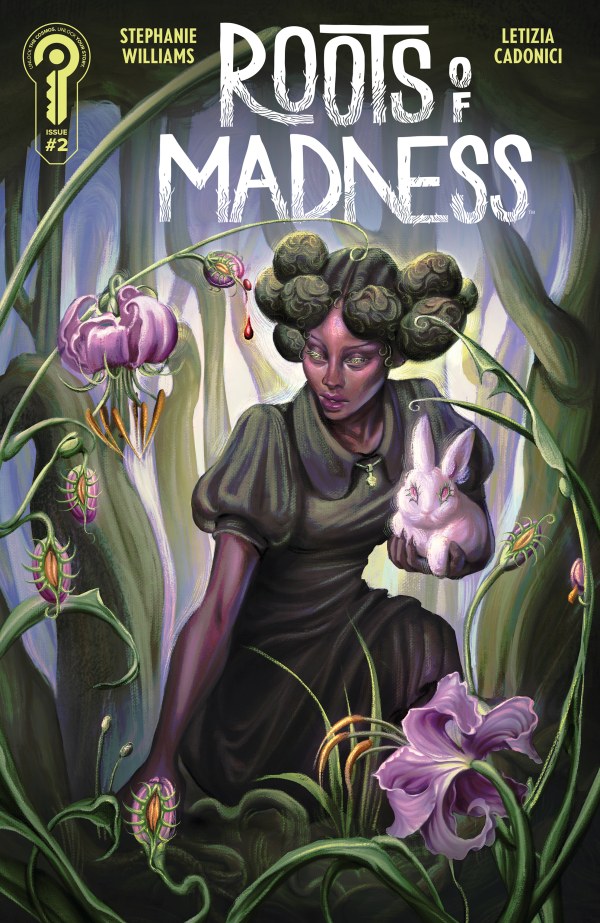
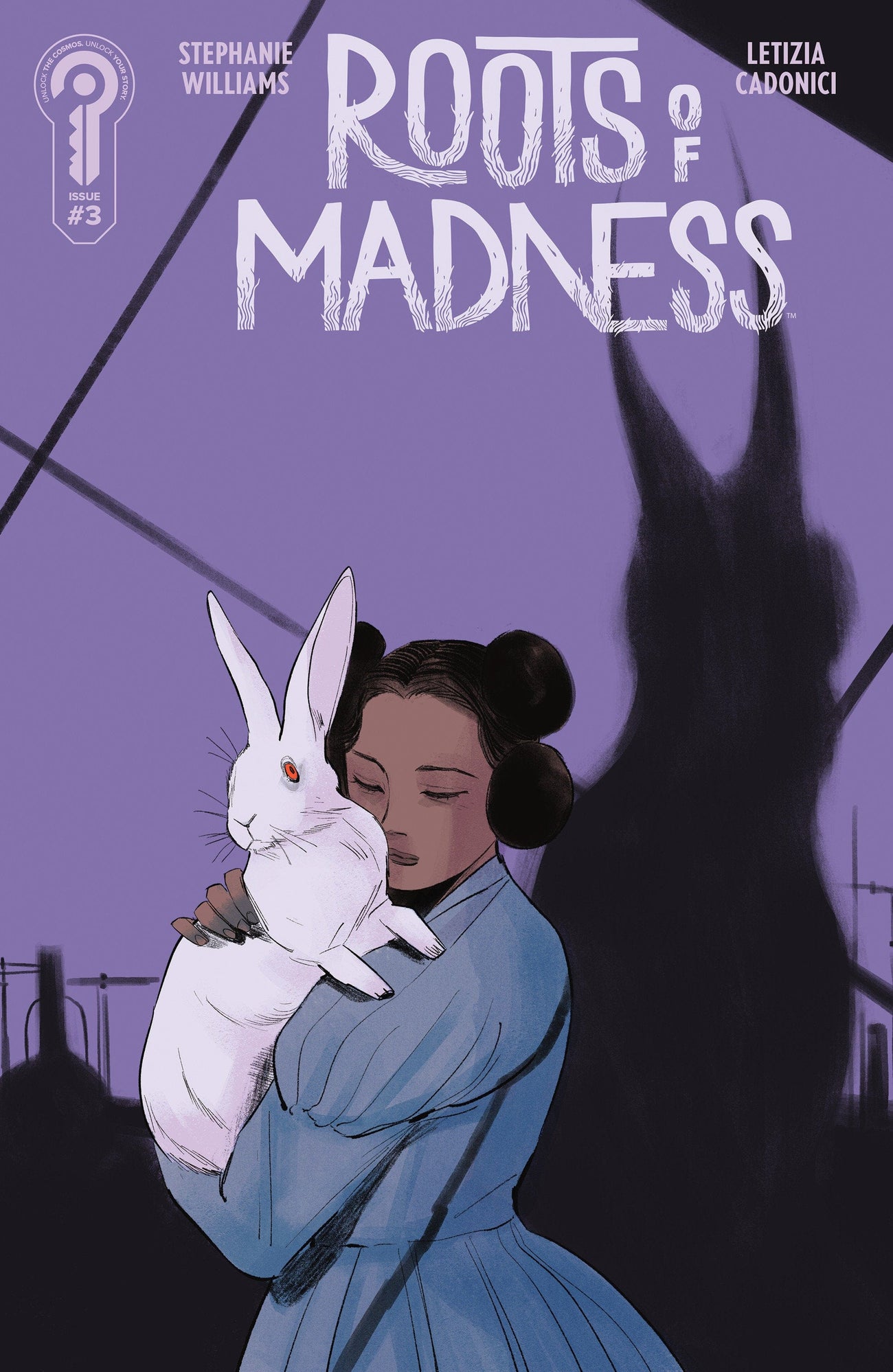
A new comic from Ignite Press by Stephanie Williams, Letizia Cadonici (main artist) and Juliet Nneka (alternate covers.) At the turn of the century, Etta, a young Black woman, studies both science and a book of old remedies she inherited from her mother, along with some dire warnings she doesn't heed.

This is a really interesting historical fantasy with elements of cosmic horror and dark academia. Each issue has alternate covers in very different styles. I like both of them.


I'll be following this one.

Content notes: So far racism is part of the world and why the characters make some choices, rather than violent or constantly present on-page. The rabbits are used in experiments that are not cruel - Etta tests a healing ointment on one that has an injury - but they seem likely to eventually turn into zombies or get possessed by cosmic horrors or merge with eldritch plants.
Thursday, January 8th, 2026 10:13 pm
How is the writing going? Anything notable to report?

Question of the day: what tendencies are you aware of in your writing that you actively try to avoid?
Thursday, January 8th, 2026 09:50 pm

[personal profile] angelofthenorth hadn't seen Glass Onion, so we're watching it tonight.

Turns out she hadn't thought of roasting cabbage until I served it -- along with roasted mushrooms and carrots and Christmasy things I'd stashed in the freezer: salmon wellington for those two and veggie pastry parcels for me -- tonight.

I am delighted to have been able to share such wonderful things.

Tags:
Thursday, January 8th, 2026 03:29 pm
Now that we are back in the swing of the year, my days are marked by doctors' appointments. I preferred being outside the calendar. I did dream briefly and unexpectedly of Alexander Knox, playing one of those harrowed, abrasive, obdurate figures on the other side of some internment or imprisonment that made me think he would have been anachronistically great as E. T. C. Werner. Have some link-like things.

1. John Heffernan falls into the category of actors of whom I have somehow become very fond without actually seeing all that much of them, which normally happens with character faces in the '40's. I am unlikely even to see his latest project, the freshly announced Amazon TV version of Tomb Raider, but since his character is described in the promotional dramatis personae as "an exhausted government official who finds himself tangled up in Lara's unusual world," it's nice to know I would almost certainly develop a disproportionate attachment to him if I had the chance. You can tell I am otherwise a solid generation of actors behind the times since I was impressed by the casting all in the same place of Jason Isaacs, Bill Paterson, Celia Imrie, Paterson Joseph, and Sigourney Weaver.

2. This song transfixed me a few nights ago on WHRB: Barbez, "Strange" (2005).

3. I meant once again to praise the Malden Public Library for ordering me a sun-bleached, peach-orange, jacketless first edition of Leslie Howard's Trivial Fond Records (ed. Ronald Howard, 1982), about whose selected nonfiction I have been intensely curious since discovering its existence in 2008, but the problem with reading some of the broadcasts he made for J. B. Priestley's Britain Speaks in 1940 is that one runs into passages like:

Democracy today, to survive at all, must be as militant as autocracy, and what the world is desperately in need of now is not the gentle, philosophic democracy of Jefferson, but the outspoken, militant and ringing democracy of Roosevelt, representing the righteous anger of the free people of the world aroused against the cynical arrogance of the totalitarian feudalists.