![[syndicated profile]](https://www.dreamwidth.org/img/silk/identity/feed.png)

Challenge #3: Write a love letter to fandom.
John Green says of going to home games for AFC Wimbledon, "I'm with 8,000 people whose love is oriented in the same direction as mine." That, to me, is fandom. It's a group of people who have oriented their love in a similar direction, whether that's toward a show or an actor or a band or a character or a hobby or something else entirely. (Honestly, love oriented in the same direction might be foundational to almost all human-built institutions, and the problem with some of them is that the object of their love doesn't inspire pro-social behavior, but that's outside the scope of this post.) It doesn't matter what the object of the love is so much as the way that all that love aimed at a similar place amplifies itself, like vector multiplication.
The funny thing is, the way I do fandom these days, It's almost less about the object of the fandom and more about the idea of fandom, the love and the passion it inspires. Which is not to say that I'm not in some fandoms. I'm very active in Star Trek fandom, and love hanging out with people who love it with me. It's always fun to find people who share some of my other current interests like Sherlock Holmes, Murder She Wrote, Superman, and Jane Austen, or to reminisce happily with people who remember the loves that I'm less active in but still remember fondly like X-Files and Stargate.
But there are definitely people in fandom spaces with whom I share no fandoms, and I still enjoy their company, because they're doing the fandom thing too. That is, they're passionate about something, and so passionate that they want to talk about the thing, and make more of the thing, and put their joy and passion into the world so that other people can share it. Elsewhere on this year's snowflake, someone mentioned how much they love seeing someone be passionate about something, even if they don't share that passion. I like that. It is a joy to see humans be happy and excited about things they love, and to be unabashedly passionate about them.
Let people enjoy things has become a meme, almost a cliche, but that's because it so often needs to be said. Fandom at its best is a safe place where people are allowed to enjoy things without mockery or disdain, and in a world where that is all too often not the case, that's a very valuable thing.
![[personal profile]](https://www.dreamwidth.org/img/silk/identity/user.png) brickhousewench tipped me to Heading Prints, a company that makes scarves using book art as inspiration. They offer bandanas, skinny scarves, large rectangular scarves, square silky scarves, and also a few rings with designs to match some of their most popular scarf designs. Also, these are much more affordable on average than most fashion scarves I've seen, although they do cost more than the cheap random ones in a discount store.
brickhousewench tipped me to Heading Prints, a company that makes scarves using book art as inspiration. They offer bandanas, skinny scarves, large rectangular scarves, square silky scarves, and also a few rings with designs to match some of their most popular scarf designs. Also, these are much more affordable on average than most fashion scarves I've seen, although they do cost more than the cheap random ones in a discount store.If you've seen my post "How to Simplify Fashion," then consider these scarves as an option for color-matching. Look for a scarf whose colors you love and want to use. Wear it while clothes shopping to test if new clothes match your colors.

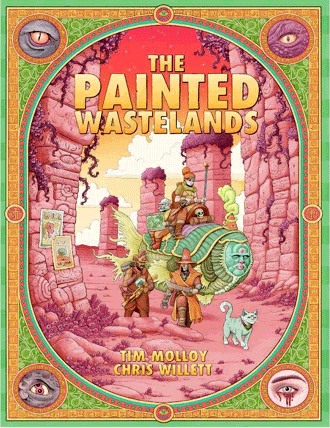
This all-new Painted Wastelands Bundle tours The Painted Wastelands, a prismatic pastel realm from Agamemnon Press for use with Old-School Essentials and other tabletop fantasy roleplaying games.
Bundle of Holding: The Painted Wastelands
Watch a film in a Celtic language every week( Read more... )
Read a book in a Celtic language every month( Read more... )

Today's writing
Slow to start, but I hope to write some more tonight. And hopefully tomorrow things will be fully back to normal. Fingers crossed!
Tally
( Days 1-5 )
Day 6:
alightbuthappypen, badly_knitted, brithistorian, carenejeans, china_shop, cornerofmadness, goddess47, luzula, sanguinity, sylvanwitch, the_siobhan, trobadora, ysilmeDay 7:
china_shop, trobadoraLet me know if I missed anyone! And remember you can drop in or out at any time. :)
This afternoon, while I was hiding from work and feeling sorry for myself because of a worsening headache, angelofthenorth asked me "So how was The Moonwalkers?"
I then talked for like fifteen minutes without stopping.
Oops.
I figured she'd have read D's entry about this from last night -- she's good like that -- so ( I started with the accessibility stuff: )
But this wasn't a huge problem, I was busy being excited about space.
"For 45 minutes I forgot about the world's problems," D said. I love that!
I...did not.
One of the Artemis II astronauts who was interviewed for this movie said something about Apollo being "ahead of its time" and immediately I was grumpily thinking no it's not! we're behind ours! JFK referencing the Wright Brothers made me ponder that it was about sixty years from them to the moonwalks, and it's been another sixty years since! What do we have to show for ourselves? (Lots of other things, I know, but no one's even left Earth orbit! Yes the ISS is cool but it's reaching the end of its lifetime, and it's still Soyuz ferrying people to and from! The splashdowns look beautiful and poetic at the end of a movie like this but where are our goddam spaceplanes?!)
Basically, everything I have to say about that I said in 2011 when the only thing more modern than Soyuz ceased operation and in 2012 when Neil Armstrong died.
But since I couldn't just link angelofthenorth to things in a real-life conversation, I had to attempt to re-create those thoughts and everything that links into them: my waning interest in "space" as the 2010s went on and SpaceX got increasingly dull (to me, I am not a rocket man) and -- even before it became so tainted by its association with Elon Musk -- depressing as a symbol of yet another thing being left to private whims which I believe is a public good. The only thing about these old entries that I wince to read tonight is my optimism and naïveté, but while I'm sad for my younger self I'm not ashamed of having those things.
Anyway. Like I said I probably talked for fifteen entire minutes without a break. I wasn't even self-conscious about it, until the end.
Luckily (?) angelofthenorth said it was cute, and endearing.

 delphi
Title: Things Wondrous and Divine
Fandom: Our Flag Means Death
Rating: Mature
Word Count: ~1300
Characters/Pairings: Frenchie/Izzy Hands
Notes/Warnings: AU: Izzy Hands Lives. Written for
Summary: The crew puts in for repairs at what turns out to be a bioluminescent bay, but Izzy and Frenchie aren't messing around with any Natural Phenomena. Or, the one where Izzy appreciates Frenchie's cynicism.
DW Link: Things Wondrous and Divine
delphiTitle: The Voyage of the Unicorn
Fandom: Our Flag Means Death
Rating: Mature
Word Count: ~1900
Characters/Pairings: Izzy Hands/Lucius Spriggs, Frenchie/Izzy Hands, Wee John Feeney/Izzy Hands, Archie/Fang/Frenchie/Izzy Hands/Jim Jimenez, Archie/Izzy Hands/Jim Jimenez, Fang/Izzy Hands/Lucius Spriggs, Izzy Hands/Roach, Izzy Hands/Jim Jimenez, Fang/Izzy Hands, past Izzy Hands/Edward Teach
Notes/Warnings: AU: Izzy Hands Lives. Written for the
![[community profile]](https://www.dreamwidth.org/img/silk/identity/community.png) 1character challenge. Also available on AO3
1character challenge. Also available on AO3Summary: Fifty one-sentence stories for fifty prompts, following Izzy’s post-series life aboard the Revenge.
1. Swords
The love of a crew can't change him into something he isn't, but their hands right his edges like a whetstone and their words leave behind the gleam of oil on steel.
DW Link: The Voyage of the Unicorn
delphiTitle: Late at My Singing
Fandom: Let This One Be a Devil
Rating: Mature
Word Count: ~1900
Characters/Pairings: Henry Naughton/The Leeds Devil
Notes/Warnings: Contains dub-con/ravishment fantasies. Written for the September 2025 Flash Round of
bethefirst Title borrowed from William Carlos Williams' "The Late Singer." Also available on AO3Summary: Henry returns to his studies in the city following his time back home in the Pine Barrens. His encounter with the Leeds Devil lingers with him, as do his questions about where a man like him belongs.
DW Link: Late at My Singing
I fed the birds. I've seen a few sparrows.
I put out water for the birds.
EDIT 1/7/26 -- I did a bit of work around the patio.
EDIT 1/7/26 -- I did more work around the patio.
EDIT 1/7/26 -- I gathered the raked leaves from the ritual meadow, enough to fill the trolley twice, which I dumped on the daffodil bed. (That should have been done in fall, but better late than never.) One quarter around the firepit equaled two trolleys and covered the daffodil bed completely. The tulip bed will need at least twice that much.
I startled several cardinals and the great-horned owl in the ritual meadow.
EDIT 1/7/26 -- I did more work around the patio.
I filled a trolley with sticks from the brushpile beside the driveway, then dumped that in the firepit.
EDIT 1/7/26 -- I filled another trolley with sticks, then dumped that in the firepit.
There's not much left of the brushpile now, mostly pieces too big for me to break down.
It's 5:05 PM. The western sky is still twilight, the east considerably darker.
I am done for the night.
I rounded out 2025 with Jacqueline Woodson’s Locomotion, the verse prequel to Peace, Locomotion. I thought Peace, Locomotion was ultimately a stronger book, but nonetheless I enjoyed spending more time with the characters.
Then I kicked off 2026 with the new Charles Lenox mystery, The Hidden City, in which Charles Lenox gently brushes against the life of the extremely poor! These books are always a good time, extremely readable, although I thought some of the backstory was unnecessarily convoluted, for reasons that I attempted to explain only for the explanation to quickly grow unwieldy. Too convoluted!
Finally - alert to my fellow Elizabeth Wein fans! She recently co-authored a book with Sherri L. Smith (of Flygirl fame), American Wings: Chicago’s Pioneering Black Aviators and the Race for Equality in the Skies, which does what it says on the tin, plus some excursions to Ethiopia during the Italian invasion of 1936, during which time Pioneering Black Chicago Aviator John C. Robinson attempted to train an Ethiopian air force despite Ethiopia’s pitiful collection of woefully outdated aircraft. It’s not the final Lion Hunters novel but I’ll take what I can get.
What I’m Reading Now
Like Tolstoy, Solzhenitsyn starts out In the First Circle by introducing dozens of characters with about three names each, and in my confusion I was flagging a bit. But then! Then Solzhenitsyn stops dead for Stalin to recount his life story! And now Stalin is meeting with head of SMERSH Abakumov (SMERSH of course stands for “Death to Spies”) who begs Stalin to bring back the death penalty. It’s so hard to keep track of who you’ve executed when you’re not officially allowed to execute people! “You might be the first one we execute,” Stalin teases(what a wag!), and Abakumov murmurs anxiously that of course if it becomes necessary…
What I Plan to Read Next
Thanhha Lai has published a sequel to Inside Out and Back Again: When Clouds Touch Us. I couldn’t bring myself to check it out because I am generally suspicious of sequels, but I know that I won’t be able to resist for long.

It's a zombie apocalypse, only instead of zombies, there's cats.

In a future in which 90% of the population owned a cat, a strange virus spreads. If you cuddle a cat, or a cat nuzzles you, you turn into a cat! It's a catastrophe! A catlamity! A nyandemic!
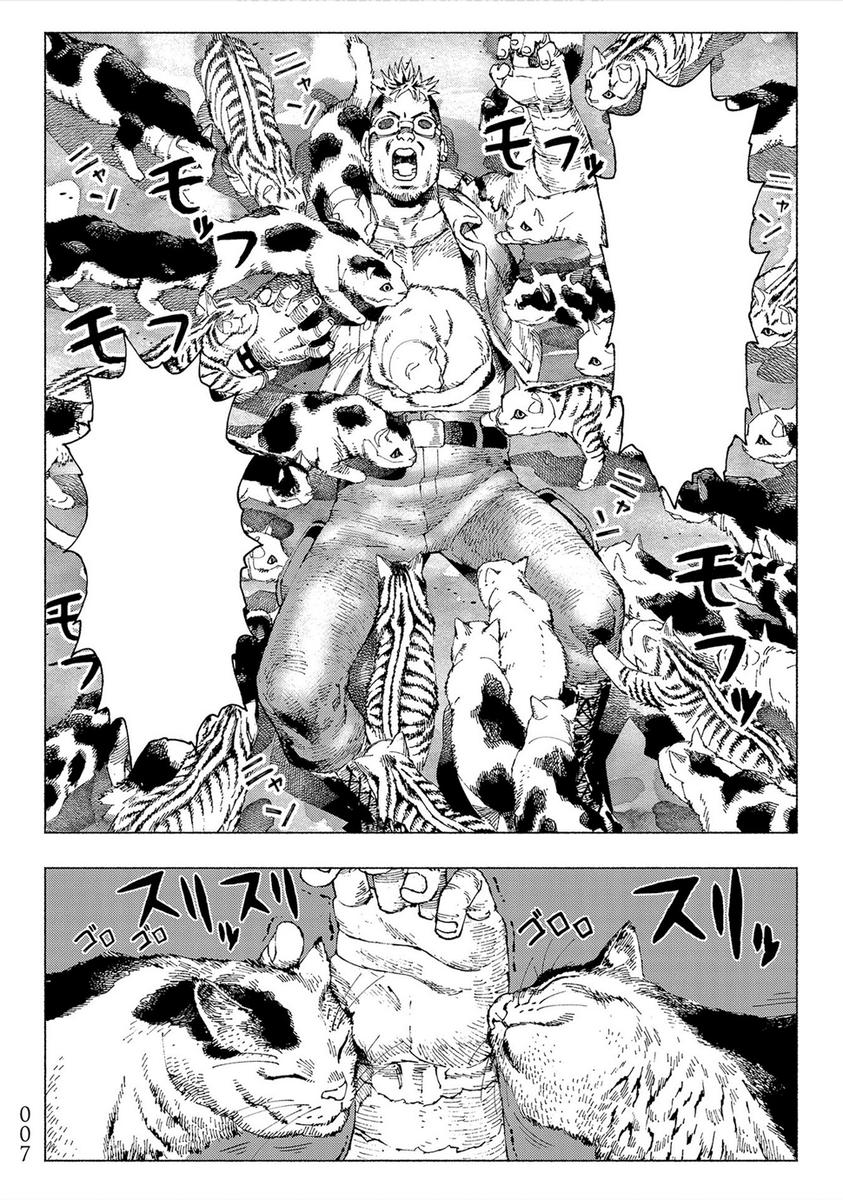
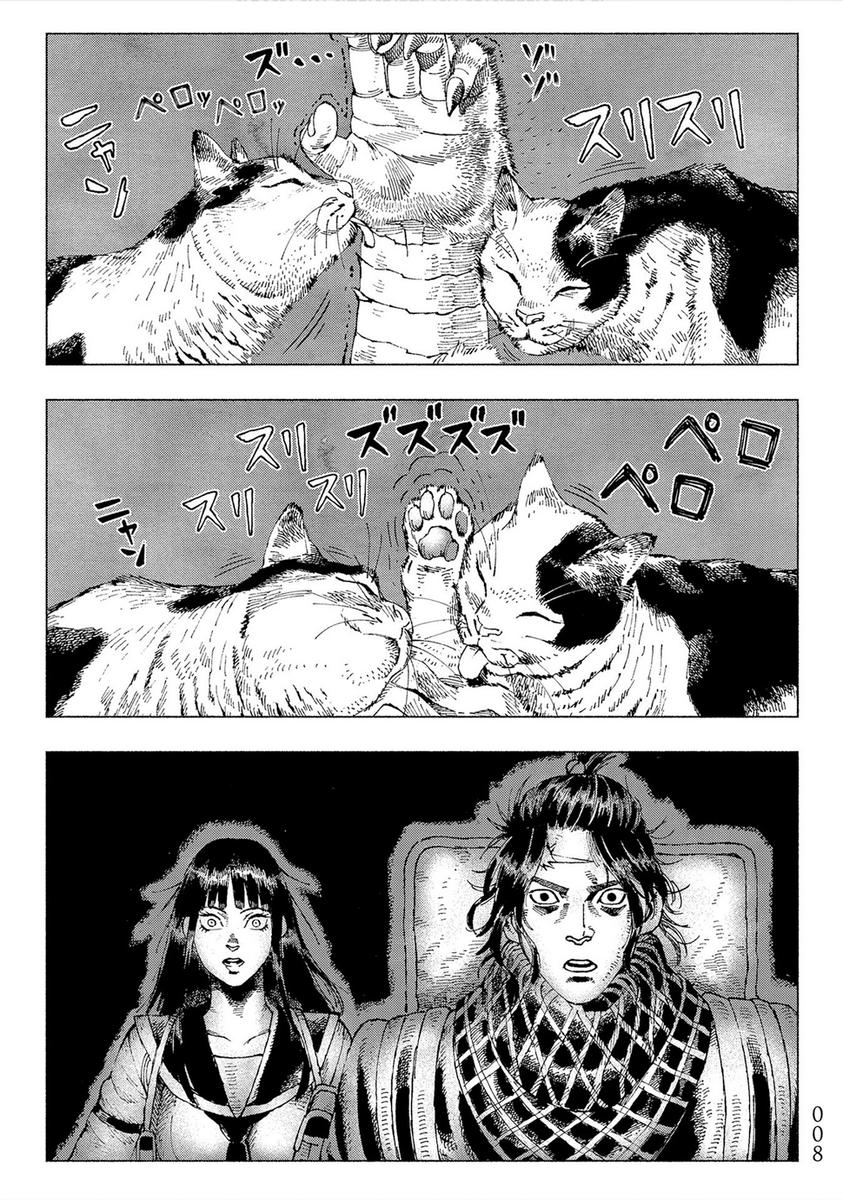
Not only are cats everywhere, but the cats are either instinctively trying to turn humans into cats, or they just want to be petted. Cue every zombie movie scene ever, but with cats. Cats scratch at the doors! Cats peer through the windows! Groups of cats ambush you in tunnels!
The characters are all very upset by this, because they love cats! And now there's cats everywhere, just begging to be skritched! And they can't skritch them! "We can't even squish their little toe beans!" The horror!
Needless to say, they would never ever harm a cat. In fact they feel bad when they're forced to spray cats with water to shoo them away.
I'm not sure how this can possibly be sustained for seven volumes, but on the other hand I could happily read seven volumes of it. The cat art is really fun and adorable. I would definitely do better in a zombie apocalypse than a cat apocalypse, because I would never be able to resist those cats.
Content notes: None, the cats are fine.
What if the Moon Didn’t Exist? Voyages to Earths That Might Have Been, Neil F. Comins. I would not call this book well-written on a prose level, but it's conceptually interesting. Comins goes through a number of different astronomical scenarios and looks at, not just what that would look like now, but how it would (likely) affect things such as the evolution of life. For example, if the moon were closer to Earth, tides would be much stronger, greatly increasing the distance covered by the tidal zone, which would make it harder for sea life to transition onto dry land.
Worth noting, though, that this was originally published in 1993, so it doesn't take into account more recent advancements in astronomy and biology. We'd just barely confirmed our first exoplanet sighting back then, and also Comins very much assumes that "life" must look like it does here. On the other hand, it's sort of charming -- in this age of climate change -- to see his final chapter explore a doomsday scenario where we've completely wrecked the ozone layer, which was a major concern at the time. (In fact the "ozone hole" is healing now, and we should be back to 1980 levels within the next couple of decades.)
Comins has another book along these lines, What If the Earth Had Two Moons?, which I may pick up. Dry prose notwithstanding, these are very interesting to read with an eye toward designing different kinds of worlds!
And Dangerous to Know, Darcie Wilde. Third in a series of Recency mysteries I started reading last year, which are very fun -- though demerits to the author, or perhaps her publisher, for the fact that A Useful Woman is NOT the first book of the "A Useful Woman" series, though both that series and this one, the "Rosalind Thorne Mysteries," involve the same characters. It's more than a little confusing.
But anyway! The premise here is that Rosalind Thorne is of a good family that (thanks to her father) fell on hard times a while ago, and so she scrapes by kind of being an assistant-slash-fixer to ladies of quality, handling everything from sending dinner party invitations to hushing up minor scandals. Naturally, the series involves her getting involved with rather more large-scale problems, which bring her into contact with both an attractive Bow Street runner and her former suitor, who unexpectedly inherited his family's dukedom and so couldn't possibly wed a gentlewoman teetering on the edge of being utterly fallen.
This is the third volume in the "Rosalinde Thorne Mysteries" series, and as the title suggests, it tangentially involves Lord Byron -- specifically, some indiscreet correspondence with him which has gone missing. (Byron himself does not appear, which I think is probably for the best.) I suspect you could hop into this series wherever you like, but there's no reason not to start at the beginning.
Copper Script, K.J. Charles. I very much enjoyed Death in the Spires and All of Us Murderers, so I went hunting for other books of Charles' that are more mystery than romance, the latter being less my cup of tea. I'm pleased to say that Copper Script breaks from the similarities shared between those other two titles -- not that the similarities were bad, but it was going to start feeling predictable if all of them followed similar beats. This one is likewise set in the early 20th century and involves a m/m romance that has to maneuver around the prejudices and laws of the time, but the main characters (a police officer and a man who, having lost one hand in WWI, now ekes out a living by analyzing handwriting) are not former lovers who had a bad falling-out some time ago, etc. The story this time is also sliiiiiiightly fantastical: the handwriting analysis slips over the line into psychic perception. Apart from that, though, it's a satisfying non-speculative mystery, with police corruption and blackmail and murder.
Some by Virtue Fall, Alexandra Rowland. In one of the months I didn't report on, I read Rowland's A Conspiracy of Truths, which is a very odd book -- the main character spends essentially the entire novel imprisoned or being shuttled between prisons, only able to affect things through the people he talks to. I enjoyed it, though certain things about the ending left a sour taste in my mouth; I'm pleased to see that the sequel may address those things.
But this is not that book! Instead it's a standalone novella (I think in the same world), focused on the cutthroat world of Shakespearean-style theatre in a land where only women, not men, are permitted to act upon the stage. The rivalry between two companies gets wildly out of hand, and mayhem ensues. The main character was slightly difficult for me to empathize with, being very much an "act first think later if ever" kind of person, but I felt it all came together pretty well in the end.
Isabella Nagg and the Pot of Basil, Oliver Darkshire. Straight-up one of my favorite things I've read recently, and also (I am not the first to make this observation) the most Pratchett-esque thing I've read not written by Terry Pratchett.
But that doesn't mean it's just a Discworld knockoff! Darkshire has built a similarly bonkers world -- e.g. the sun beetle does not travel at a steady pace across the sky and sometimes decides to turn around, making the length of a day rather difficult to guess at -- but his leaping-off point is a story from the Decameron, and the overall vibe is much more medieval English smashed into the Romantics (a Goblin Market plays a large role in the story). You'll know if you want to read this one about three pages in; either you vibe instantly with the voice or you don't. I did, and I'm looking forward to the sequel even though the protagonist of that one is a thoroughly unsympathetic antagonist from this book.
Audition for the Fox, Martin Cahill. Novella about a character who needs to win the patronage of one of ninety-nine gods and has already failed with ninety-six of them, so she tries the trickster fox god. Surprise, he throws her a curveball! She winds up in the past, assigned to make sure a key event happens in the revolution that freed her country from the grip of its invaders.
I loved the folkloric interludes here (stories of the Fox and other gods), and the fact that Cahill doesn't have his heroine single-handedly win a war. Her job is merely to facilitate one specific event, which is one of many dominoes whose fall started decades of fighting. Which doesn't make it not important! I love how that part played out. But it's also not One Person Saves The Day, which is very, very good.
The Wordhord: Daily Life in Old English, Hana Videen. I had managed to overlook the subtitle, so I thought this book was primarily about language; turns out it's halfway between that and the kind of daily life book I read on the regular anyway. Videen digs into different aspects of life and looks at the words used back in Anglo-Saxon days, seeing how they do and do not map to the words we use today, and how vocabulary reveals the ways things got categorized and connected and what this means for how people lived. Being a language and culture nerd, naturally I found this right up my alley!
A Letter to the Luminous Deep, Sylvie Cathrall. My other favorite thing I've read recently! I think it's no accident that both this and Isabella Nagg and the Pot of Basil are very quirky in their premises and voice-y in their execution.
Here the voice is Victorian-style letter-writing, and the premise is a world (you're soon able to guess it's a colonized planet) where, thanks to a catastrophe in the distant past, everybody has to eke out a living on an ocean where there's basically only one landmass of anything like meaningful size. Society is organized around Scholars in different fields -- a concept that extends to things like art -- and the main body of the story is the correspondence between a Scholar of Boundless Campus (a fleet of migratory vessels) and a woman who lives a shut-in life in the underwater habitat built by her eccentric Scholar mother. Around that you get a second set of letters between the siblings of those two, who are trying to piece together what led up to the explosion that destroyed the habitat and caused the main characters to disappear.
Cathrall does have to indulge in a bit of contrivance to get the whole story into letters, diaries, or other written documents, and to control the pacing of reveals. But I didn't mind, because it all just felt so original and engaging! This is the first book of a duology, and I promptly ordered the sequel, which is sitting on my desk as I type this.
City of Iron and Ivy, Thomas Kent West. Disclosure: this book was sent to me for blurbing purposes.
Alternate-history fantasy, in an England where floral magic is put to uses both trivial and epic, both fair and foul. The era is essentially Victorian, but West acknowledges in the afterword that he's taken a number of liberties with the period. That includes the Reaper, who is obviously meant to be an analogue to Jack the Ripper (the story starts in 1888), but -- and for me, this was crucial -- is different enough that it didn't trip my very strong opinions about how to handle the historical evidence of those murders.
But it is not entirely a story about murders. Elswyth, a scarred young lady, has to come to London to seek a husband after her more beautiful and sociable sister Persephone disappears, because otherwise she'll have no future and her father's entire estate will go to a loathesome cousin. Only Elswyth is convinced her sister's disappearance has to do with the Reaper, and furthermore that the Reaper is probably a gentleman or noble, so her attempt to navigate that world is cover for her investigation.
I read the whole thing in about a day, and very much appreciated the ways in which the ending eschews some of the easy resolution I anticipated. I don't know if there will be a sequel, but some dangling threads are left for one, while the main plot here resolves just fine.
The Tinder Box, M.R. Carey. Disclosure: this book was also sent to me for blurbing purposes. (I read three such over the holidays, but finished the third after the New Year.)
Labeling this one "historical fantasy" is kind of interesting, because it both is and it isn't. I'd almost call it Ruritanian fantasy, except that term means works set in a secondary world without magic, whereas this is more Ruritanian in the original sense of the word: it takes place in an imaginary European country (circa the late 18th century), and then adds magic to that. If it weren't for a couple of passing references to real places and the fact that Christianity is central to the tale, it could almost be a secondary world.
Anyway, genre labeling isn't the important thing here. The story involves a soldier demobbed from his king's stupid war due to injury, who finds that making a living back home is easier said than done, thanks to the peasantry being squeezed to the breaking point and beyond by said war. He's employed for a time with an unfriendly widow, only for everything to go haywire when a giant devil falls dead out of the sky and the widow, who turns out to be a witch, pays him to loot the body. He pockets one innocuous-seeming item for himself -- a tinder box -- which of course turns out to be exactly what the witch was looking for, and so begins a chase.
I think of this book as being anti-grimdark in kind of the same way I used that term for Rook and Rose: it starts out there, but it doesn't stay there. Mag is living on the edge of starvation and then makes a variety of incredibly stupid decisions in how he uses the tinder box (in fairness, partly due to repeatedly not having time to think things through), while Jannae, the witch, is deeply untrusting of everyone and everything. Meanwhile, the tinder box turns out to contain three trapped devils, and I'm often leery of "deals with the devil" type stories. But I loved the direction Carey took this in, and the ultimate trajectory is toward hope and healing rather than pyrrhic victories. It's a standalone, and absolutely fine that way; you get a complete meal here, without being teased with anything more.
(originally posted at Swan Tower: https://is.gd/TE2qj6)
Any website that you like, be it fanfiction, art, social media, or something a bit more eccentric!
On many of the fannish websites we use, our history is easily compileable into "pages". When we look back through those pages, sometimes we stumble upon things that we think are rather cool.
( Read more... )
Having just spent a week in close quarters with two large German Shepherds and a big German Shepherd mix, I was primed to learn about the Indian Pariah Dog, which somehow crossed the path of my consciousness yesterday.
Observing the behavior and ability of the German Shepherds, and reading about the history and canine qualities of the Indian Pariah Dog, I became fascinated by how different are the aptitudes and characteristics of various types of dogs, yet all domestic dogs are the same species, Canis familiaris, or more technically, a subspecies of the gray wolf, Canis lupus, hence Canis lupus familiaris, and have been so for more than ten thousand years of evolution.
The Indian dog, Indie dog, South Asian dog, or Desi Kutta, is a landrace of dog native to the Indian subcontinent. They have erect ears, a wedge-shaped head, and a curved tail. It is easily trainable and often used as a guard dog and police dog. This dog is an example of an ancient group of dog known as pye-dogs. There is archaeological evidence that the dog was present in Indian villages as early as 4,500 years ago.
Though most street dogs in the Indian subcontinent are in fact Indian pye-dogs, the names for this breed are often erroneously used to refer to all urban South Asian stray dogs despite the fact that some free-ranging dogs in the Indian subcontinent do not match the "pariah type" and may not be pure indigenous dogs but mixed breeds, especially around locations where European colonists historically settled in India, due to admixtures with European dog breeds.
(WP)
I was particularly captivated by the Indian pariah dog for a number of reasons, including its name, which I will discuss more below, its overlap with the Pye-dog, and the fact that Indian friends said that it has been well suited to its environment for five millennia or more.
Here's how WP begins its article on the Pye Dog:
The Indian Pariah Dog, also known as the village dog, Pye Dog, Indian Native Dog, or more modernly INDog, is an ecologically adapted dog with stray/wild habits that occupies the ecological niche of a scavenger in human settlements. These dogs are typical of the Indian subcontinent, but can also be found in the Balkan Peninsula and in less developed countries.
The term "Pariah" originates from the Tamil word meaning "outcast", which the British used to refer to stray dogs typically living on the outskirts of villages in India. The first recorded use of the term "yellow pariah dog" was by Rudyard Kipling in The Jungle Book.
Many kennel clubs now prefer the term primitive dog to describe dogs of the pariah type, reflecting their close resemblance to early domesticated dogs. The Primitive and Aboriginal Dogs Society reclassifies Pariah Dogs as INDogs and categorizes them as a subgroup of primitive and aboriginal dogs.
…
India hosts large populations of these village dogs, with significant numbers and a wide variety of indigenous breeds. Archaeological research suggests that Indian Pariah Dogs date back at least 4,500 years.
In India, Pariah Dogs are known by various names such as Nedi Kukur, Deshi Kukur, Deshiya Naayi, Deshi Kutra, Theruvu Naai, Deshi Kutta, Theru Naai, Deshi Kukura, Veedhi Kukka, and Deshi Kutro. In Bangladesh, they are referred to as Nedi Kukur and Deshi Kukur. More recently, they are commonly called INDogs.
The definition of "village" is quite vague, as a village can range from a few hundred homes to tens of thousands. Thus, categorizing village or Pariah Dogs is challenging. Generally, these dogs share the characteristic of not being confined but being closely associated with human dwellings. Another factor to consider is that dogs in larger villages depend entirely on humans for food (both waste and otherwise) and rarely leave the village. In contrast, in smaller villages, these dogs have opportunities to interact with wildlife, potentially increasing such interactions.
Two categories of dogs are excluded from this definition:
-
- dingoes, which are independent of human subsidies or interactions, primarily found in Australia and limited by human persecution;
- working dogs, which are specifically bred and trained to interact with wildlife, used in hunting wild animals or protecting domestic ungulates (sheep, cattle, etc.) from wildlife.
(WP)
From my studies of the Indian caste system, I was familiar with the Tamil term "pariah" meaning "outcast":
From Tamil பறையர் (paṟaiyar), from பறையன் (paṟaiyaṉ, “drummer”), from பறை (paṟai, “drum”) or from Malayalam പറയർ (paṟayaṟ), from പറയൻ (paṟayaṉ, “drummer”), from പറ (paṟa, “drum”). Parai in Tamil or Para in Malayalam refers to a type of large drum designed to announce the king’s notices to the public. The people who made a living using the parai were called paraiyar; in the caste-based society they were in the lower strata, hence the derisive paraiah and pariah.
Alternatively, derived from Sanskrit पर (para, “distant; outsider”). (Can this(+) etymology be sourced?)
Pariah comes from Tamil paṟaiyan and its Malayalam equivalent paṟayan, words that refer to a member of a Dalit group of southern India and Sri Lanka that had very low status in the traditional caste system of India. (The plural of the Tamil word paṟaiyan is paṟaiyar. The symbol ṟ in this Tamil word transliterates a letter pronounced as an alveolar trill in some dialects of Tamil, while it transliterates a letter pronounced as an alveolar liquid in Malayalam.) Because of their low status, the paṟaiyar found work performing undesirable tasks considered ritually impure by members of the higher castes, such as disposing of the corpses of dead cattle and performing music and carrying out other functions at funerals. The term paṟaiyar is derived from paṟai (in Malayalam, paṟa), a name of a kind of drum played as part of certain festivals and ceremonies. Players of this drum have traditionally been drawn from the paṟaiyar group. The word pariah begins to appear in English in travelers' accounts of Indian society and at first refers specifically to the low-status paṟaiyar. One such occurrence of the word dates from as early as 1613. As British colonial power began to expand in India, however, the British began to use the word pariah in a general sense for any Indian person considered an outcaste or simply of low caste in the traditional Indian caste system. By the 1800s, pariah had come to be used of any person who is despised, reviled, or shunned.
(AH 5th ed.)
Naturally, I wondered how one gets from "Pariah Dog" to "Pye Dog". I just assumed that "pye" is a clipped version of "pariah". Trusty old Hobson-Jobson (1886) to the rescue:=
I'm intrigued by feral dogs, stray dogs, and street dogs, wherever they may occur in the world, inasmuch as they are animals that went through domestication, and subsequently became wild again to one degree or another. Since there are so many of them running around on the streets of Taiwan, I'm especially captivated by the Formosan Mountain Dog. China (PRC / CCP) would club them all to death without a moment's hesitation.
Afterword: Kipling and Indian dogs
- Highly Social Hunters: Dholes live and hunt in large clans, using teamwork to take down prey much larger than themselves, including deer and even wild boar.
- Distinctive Communication: Instead of howling or barking, dholes communicate using unique whistle-like calls, which helps them coordinate in thick vegetation.
- Feared Predators: In The Second Jungle Book, they are described as such a terrible force that "Even Hathi [the elephant] moves aside from their line". The story culminates in a major battle where the wolf leader, Akela, dies fighting them.
- Physical Appearance: They are reddish-brown, often described as fox-faced, with a thick muzzle and dark, bushy tails.
- Scavengers: These dogs occupy an ecological niche as scavengers in human settlements and their lives are often characterized by a constant search for food.
- Appearance: Kipling often described them as the "yelping, yellow crew" or "yellow pariah-dogs".
- Behavior: In stories like "Garm – a Hostage," he portrayed them as half-wild, starving, and cowardly individually, but dangerous when they gathered in a pack.
Selected writings
- "Canine intonations" (3/21/22)
- "Annoyed dog responding to the Islamic 'Call to Prayer'" (12/29/15) — this is a classic, but presently not available on YouTube. Does anyone know where else it might be found? [UPDATE 9/22/22: found it here]
- "Canine backtalk" (10/25/19) — this darling dog could have a conversation of sorts with Izzy, but they speak different lects.
- "Talking seals and singing dogs" (11/28/03)
- "Of dogs and Old Sinitic reconstructions" (3/7/18)
One witness told Sahan Journal she saw first responders performing CPR on someone at E. 34th Street and Portland Avenue. The person had blood on their face and in their hair.
by Becky Z. Dernbach, Andrew Hazzard, Katelyn Vue, Shubhanjana Das and Mohamed Ibrahim
https://sahanjournal.com/immigration/federal-shooting-ice-immigration-south-minneapolis-34th-portland/
Much of the talk surrounding the Minnesota governor’s race has focused on Gov. Tim Walz dropping out. And while many Republicans wanted Walz gone, “an early exit from his re-election campaign presents its own challenges,” according to the Minnesota Star Tribune, including how to pivot from a fraud-focused strategy to other issues. Via MinnPost
https://www.startribune.com/after-focus-on-walz-and-fraud-what-comes-next-for-gop-in-governors-race/601558163?utm_source=gift
Axios is reporting that the Trump administration “is freezing $10 billion in funds for child care and poor families in five blue states.” California, Colorado, Illinois, New York and Minnesota have seen these funds suspended, and these five states “will also be asked to provide additional information, including attendance records, inspection reports and complaints from parents.” Via MinnPost
https://www.axios.com/2026/01/05/trump-child-care-minnesota ( Read more... )