Tuesday, January 6th, 2026 01:19 pm

Most travellers to the Emorian borderland take the opportunity to visit the capital of Emor, located immediately north of the borderland.

With walls higher and thicker than those of any other city in the Three Lands, Emor's capital looks from the outside to be a garrisoned fort. This appearance is deceptive. Once you pass through the heavily guarded gates, you will find yourself in a bustling city, full of trade and games.

My strong advice is that your first task should be to find a place to stay. The capital's inns are crowded year-round; the more crowded they are, the higher the prices they charge. If it is at all possible, see whether you can find an acquaintance to stay with – though I'm bound to say that the capital's residents are so used to "friends" showing up at their homes without notice that many of them now charge boarding fees almost as high as those charged by the inns.

You could easily spend a year perusing all the sights in Emor. I can only touch on a few of them here.


[Translator's note: The gates to Emor's capital feature in a spiritual vision in Death Mask.]

Tuesday, January 6th, 2026 05:08 pm

Posted by ARRAY(0x55fd8036a8f0)

This guide was co-written by Andrew Zuker with support from the Heinrich Boell Foundation.

The U.S. government publishes volumes of detailed data on the money it spends, but searching through it and finding information can be challenging. Complex search functions and poor user interfaces on government reporting sites can hamper an investigation, as can inconsistent company profiles and complex corporate ownership structures. 

This week, EFF and the Heinrich Boell Foundation released an update to our database of vendors providing technology to components of the U.S. Department of Homeland Security (DHS), such as Immigration and Customs Enforcement (ICE) and Customs and Border Protections (CBP). It includes new vendor profiles, new fields, and updated data on top contractors, so that journalists and researchers have a jumping-off point for their own investigations.

Access the dataset through Google Sheets (Google's Privacy Policy applies) or download the Excel file here

This time we thought we would also share some of the research methods we developed while assembling this dataset.

This guide covers the key databases that store information on federal spending and contracts (often referred to as "awards"), government solicitations for products and services, and the government's "online shopping superstore," plus a few other deep-in-the-weeds datasets buried in the online bureaucracy. We have provided a step-by-step guide for searching these sites efficiently and help tips for finding information. While we have written this specifically with DHS agencies in mind, it should serve as a useful resource for procurement across the federal government. 


1. Procurement Sites: FPDS.gov and USASpending.Com 

Federal Procurement Data System - fpds.gov

The Federal Procurement Data System (FPDS) is the best place to start for finding out what companies are working with DHS. It is the official system for tracking federal discretionary spending and contains current data on contracts with non-governmental entities like corporations and private businesses. Award data is up-to-date and includes detailed information on vendors and awards which can be helpful when searching the other systems. It is a little bit old-school, but that often makes it one of the easiest and quickest sites to search, once you get the hang of it, since it offers a lot of options for narrowing search parameters to specific agencies, vendors, classification of services, etc. 

How to Use FDPS
To begin searching Awards for a particular vendor, click into the “ezSearch” field in the center of the page, delete or replace the text “Google-like search to help you find federal contracts…” with a vendor name or keywords, and hit Enter to begin a new search. 
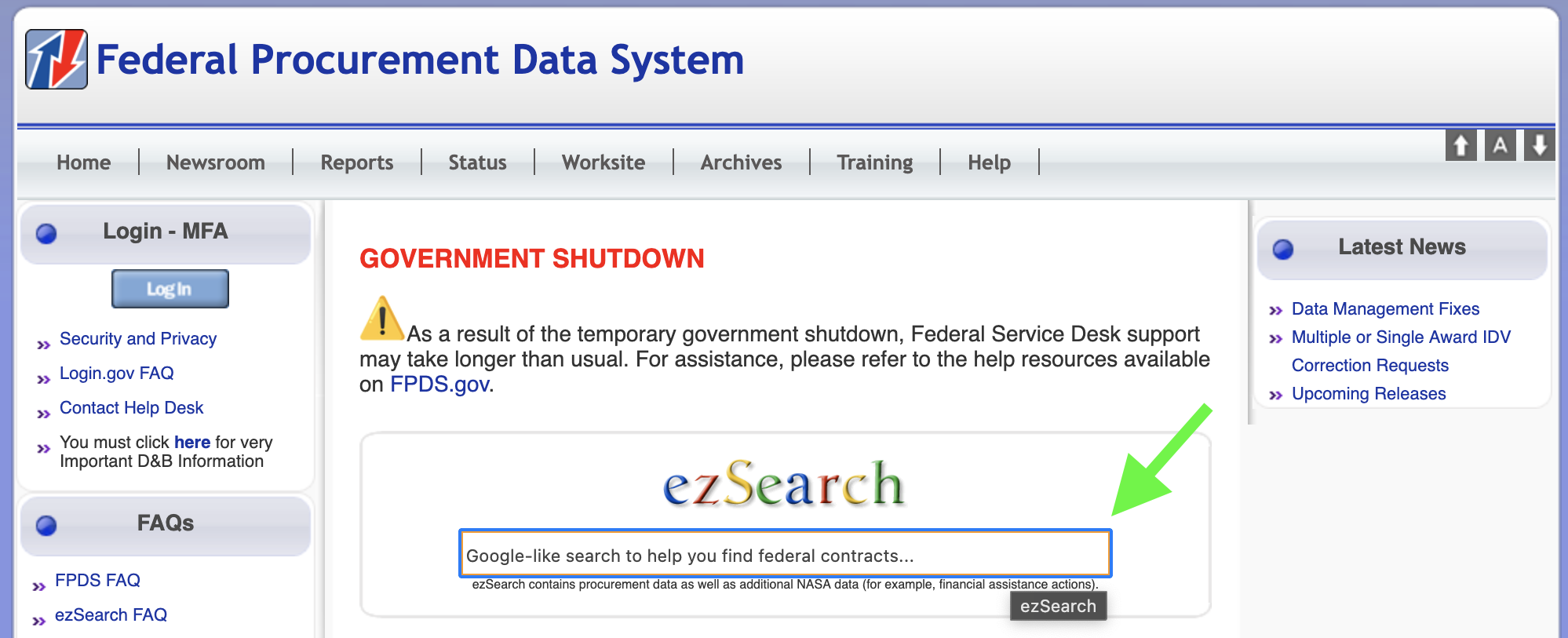
The EZ Search landing page for FPDS.gov

A new tab will open automatically with exact matches at the top. 
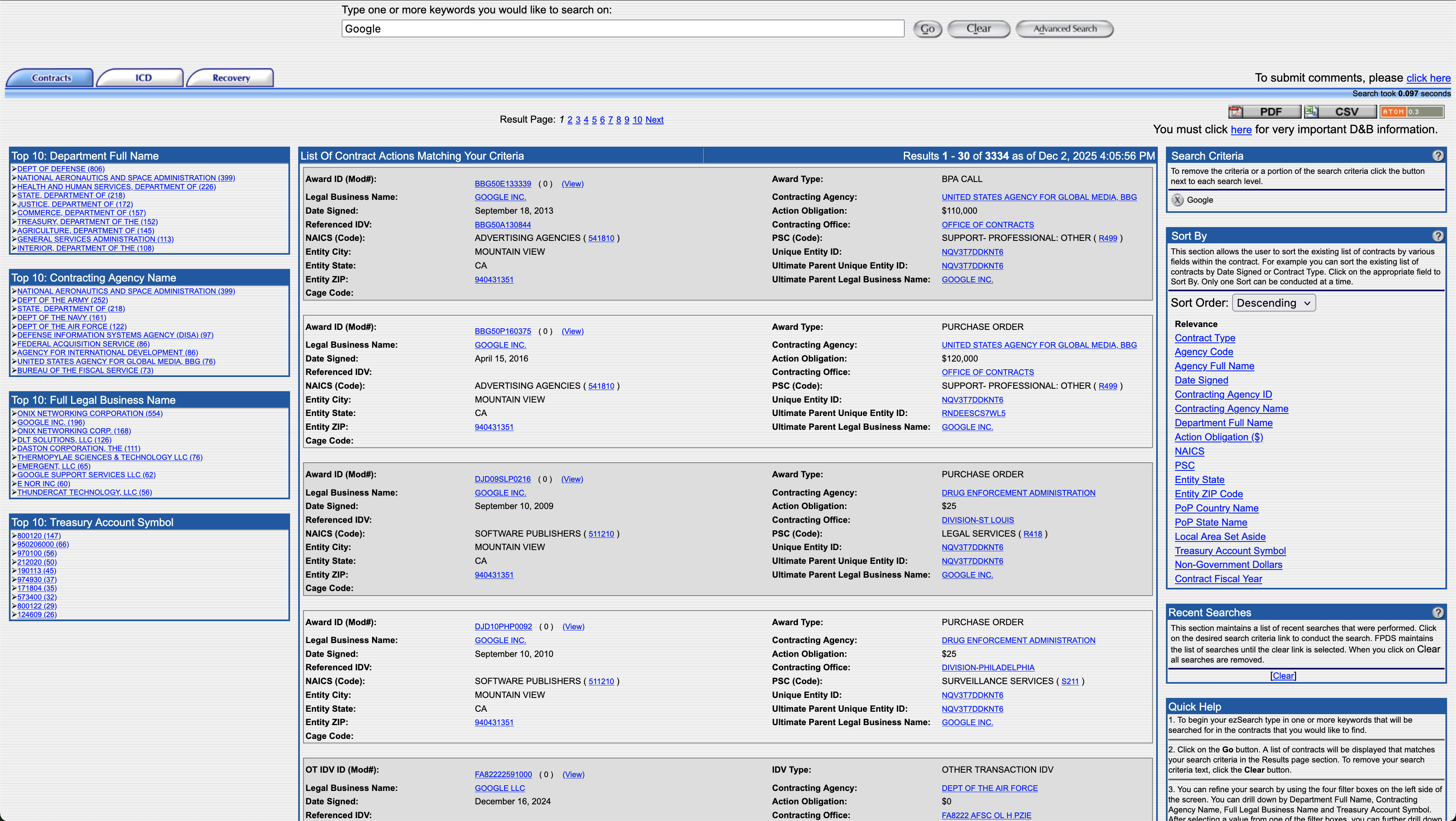
A page of results for Google's contracts with the federal government.

Four “Top 10” modules on the left side of the page link to top results in descending order: Department Full Name, Contracting Agency Name, Full Legal Business Name, and Treasury Account Symbol. These ranked lists help the user quickly narrow in on departments and agencies that vendors do business with. DHS may not appear in the “Top 10” results, which may indicate that the vendor hasn’t yet been awarded DHS or subagency contracts.

For example, if you searched the term “FLIR”, as in Teledyne FLIR who make infrared surveillance systems used along the U.S.-Mexico border, DHS is the 2nd result in the “Top 10: Department Full Name” box. 
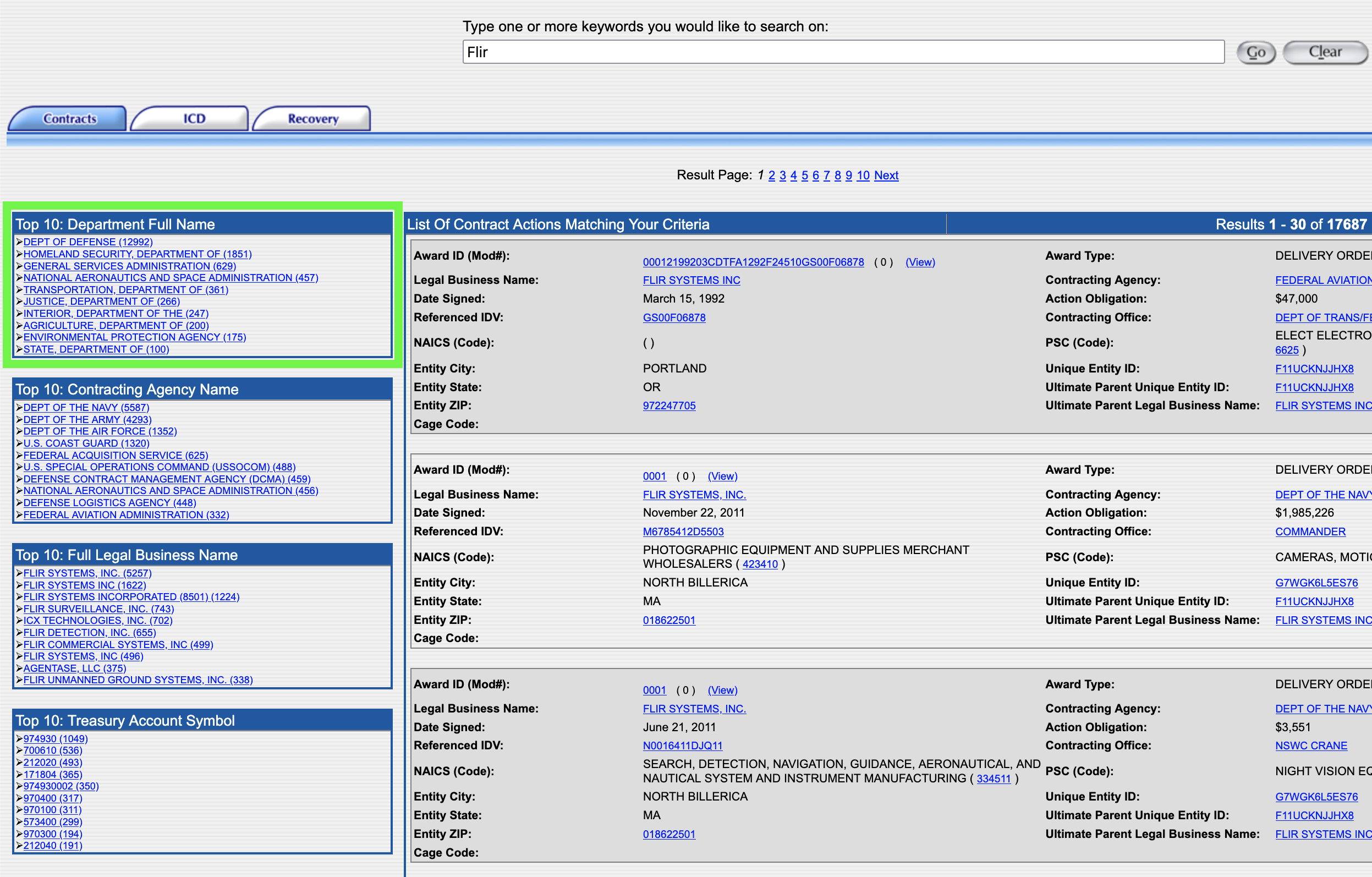
FDPS.gov results for FLIR with the agency full name sidebar highlighted.

To see all DHS contracts awarded to the vendor, click “Homeland Security, Department of” from the “Top 10 Department Full Name” module. When the page loads, you will see the subcomponents of DHS (e.g., ICE, CBP, or the U.S. Secret Service) in the lefthand menu. You can click on each of those to drill down even further. You can also drill down by choosing a company. 

Sorting options can be found on the right side of the page which offer the ability to refine and organize search results. One of the most useful is "Date Signed," which will arrange the results in chronological order. 
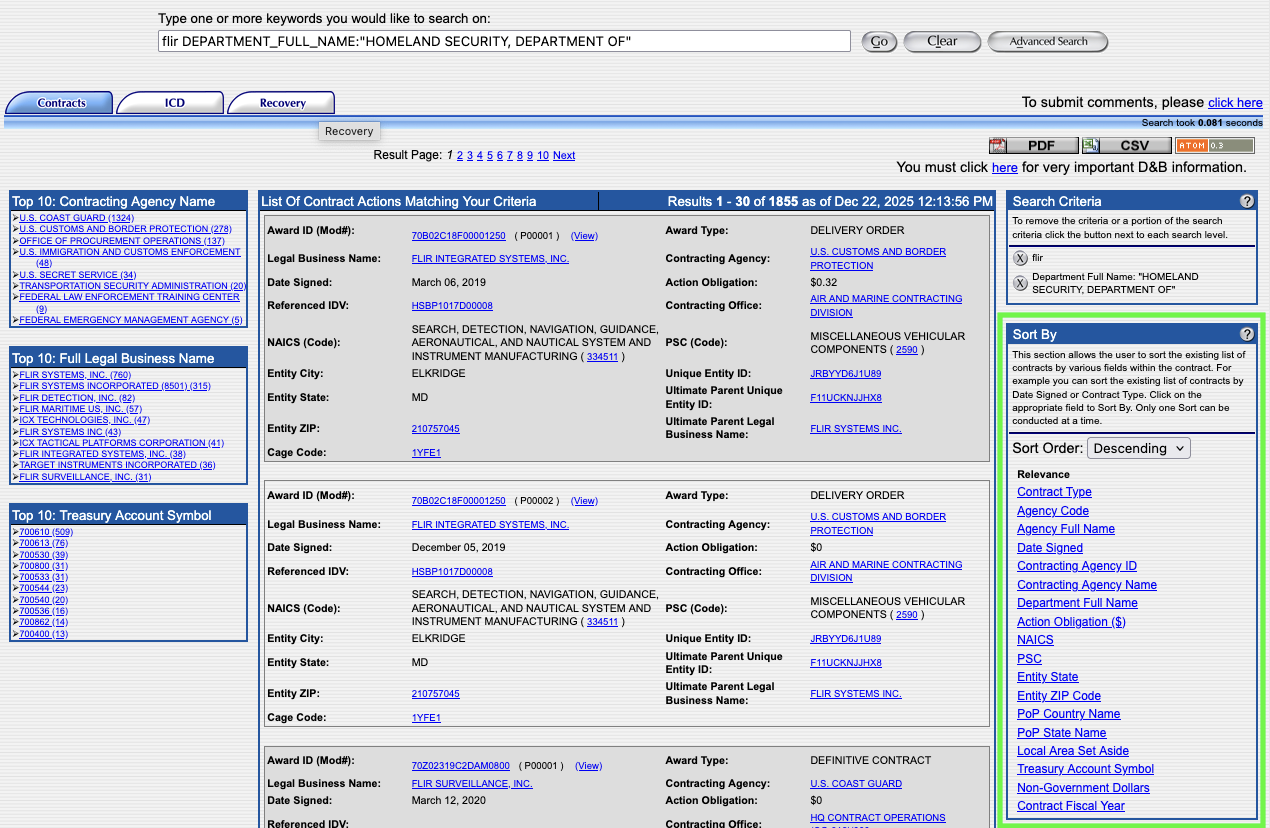
FPDS.gov results for FLIR with the sort by sidebar highlighted

You don't have to search by a company name. You can also use a product keyword, such as "LPR" (license plate reader). However, because keywords are not consistently used by government agencies, you will need to try various permutations to gather the most data. 

Each click or search filter adds a new term to the search both in the main field at the top and in the Search Criteria module on the right. They can be deleted by clicking the X next to the term in this module or by removing the text in the main search field.

FPDS.gov results with the sidebar for deselecting terms highlighted with an arrow.

For each contract item, you can click "View" to see the specific details. However, these pages don't have permalinks, so you'll want to print-to-pdf if you need to retain a permanent copy of the record. 

Often the vendor brand name we know from their marketing or news media is not the same entity that is awarded government contracts. Foreign companies in particular rely on partnerships with domestic entities that are established federal contractors. If you can’t find any spending records for a vendor, search the web for information on the company including acquisitions, partnerships, licensing agreements, parent companies, and subsidiaries. It is likely that one of these types of related companies is the contract holder. 

USA Spending - usaspending.gov

The Federal Funding and Accountability Act (FFATA) of 2006 and the DATA Act of 2014 require the government to publish all spending records and contracts on a single, searchable public website, including agency-specific contracts, using unified reporting standards to ensure consistent, reliable, searchable data. This led to the creation of USA Spending (usaspending.gov). 

USA Spending is populated with data from multiple sources including the Federal Procurement Data System (fpds.gov) and the System for Awards Management (sam.gov - which we'll discuss in the next section). It also compiles Treasury Reports and data from the financial systems of dozens of federal agencies. We relied heavily on Awards data from these systems to verify vendor information including contracts with the DHS and its subagencies such as CBP and ICE. 

USA Spending has a more modern interface, but is often very slow with the information often hidden in expandable menus. In many ways it is duplicative of FPDS, but with more features, including the ability to bookmark individual pages. We often found ourselves using FPDS to quickly identify data, and then using the "Award ID" number to find the specific record within USA Spending. 

USA Spending also has some visualizations and ways to analyze data in chart form, which is not possible with the largely text-based FPDS. 

How to Use USA Spending

To begin searching for DHS awards, click on either “Search Award Data” on the navigation bar, or the blue “Start Searching Awards”button. 
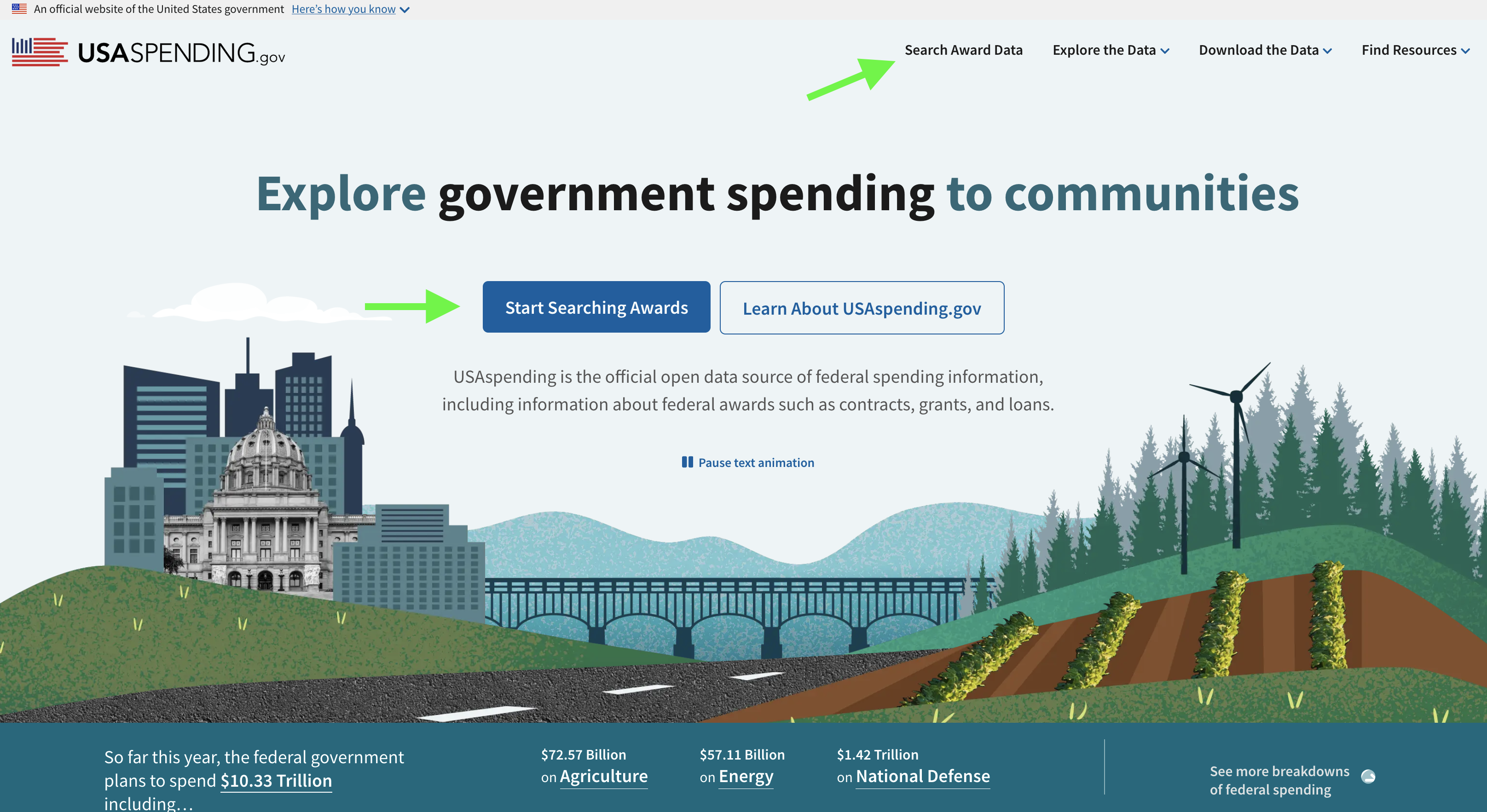
The landing page of USA Spending with arrows pointing to the search links.

On the left of the Search page are a list of drop down menus with options. You can enter a vendor name as a keyword, or expand the “Recipient” menu if you know the full company name or their Unique Entity Identifier (UEI) number. Expand the “Agency Tab” and enter DHS which will bring up the Department of Homeland Security Option.
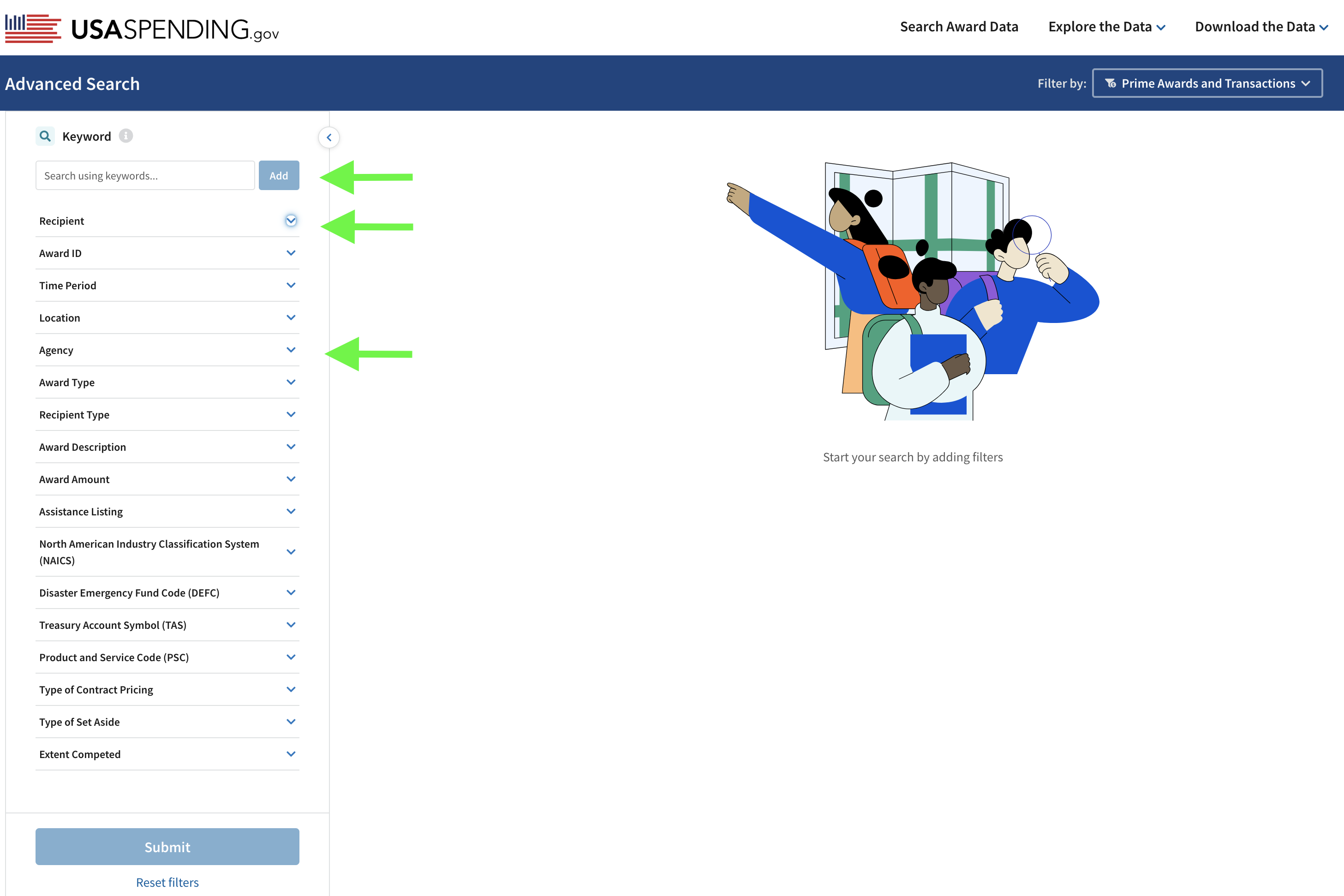
USA Spending page with arrows pointing to the key search filters.

In the example below, we entered “Palantir Technologies” as a keyword, and selected DHS in the Agency dropdown:

Search results showing Palantir contracts

For vendors with hundreds of contracts that return many pages of results, consider adding more filters to the search such as a specific time period or specifying a Funding Agency such as ICE or CBP. In this example, the filters “Palantir Technologies” and “DHS” returned 13 results (at the time of publication). It is important to note that the search results table is larger than what displays in that module. You can scroll down to view more Awards and scroll to the right to see much more information. 

Scroll down outside of that module to reveal more info including modules for Results by Category, Results over Time, and Results by Geography, all of which can be viewed as a list or graph. 
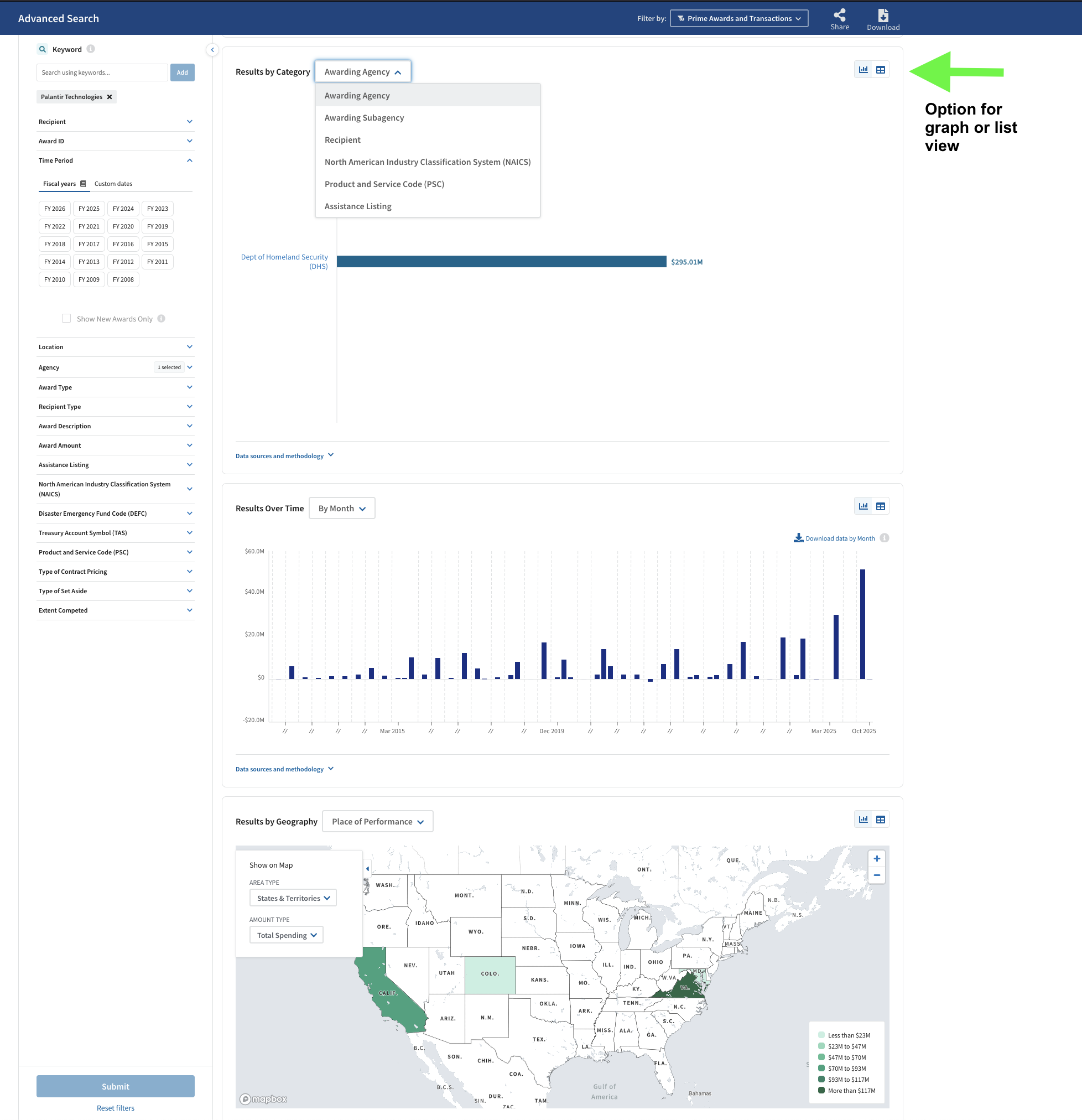
USA Spending page with graphs and charts

Once you've identified a contract, you can click the "Prime Award ID" to see the granular details for each time. 

From the search, you can also select just the agency to see all the contracts on file. Each agency also has its own page showing a breakdown for every fiscal year of how much money they had to spend and which components spent the most. For example, here's DHS's page.

2. Contracting Opportunities  - SAM.gov  

So far we've talked about how to track contracts and spending, but now let's take a step back and look at how those contracts come to be. The System for Award Management, SAM.gov, is the site that allows companies to see what products and services the government intends to buy so they can bid on the contract. But SAM.gov is also open to the public, which means you can see the same information, including a detailed scope of a project and sometimes even technical details. 

How to Use Sam.gov

SAM.gov does not require an account for its basic contracting opportunity searches, but you may want to create one in order to save the things you find and to receive keyword- or agency-based alerts via email when new items of interest are posted. 

First you will click "Search" in the menu bar, which will bring you to this page: 
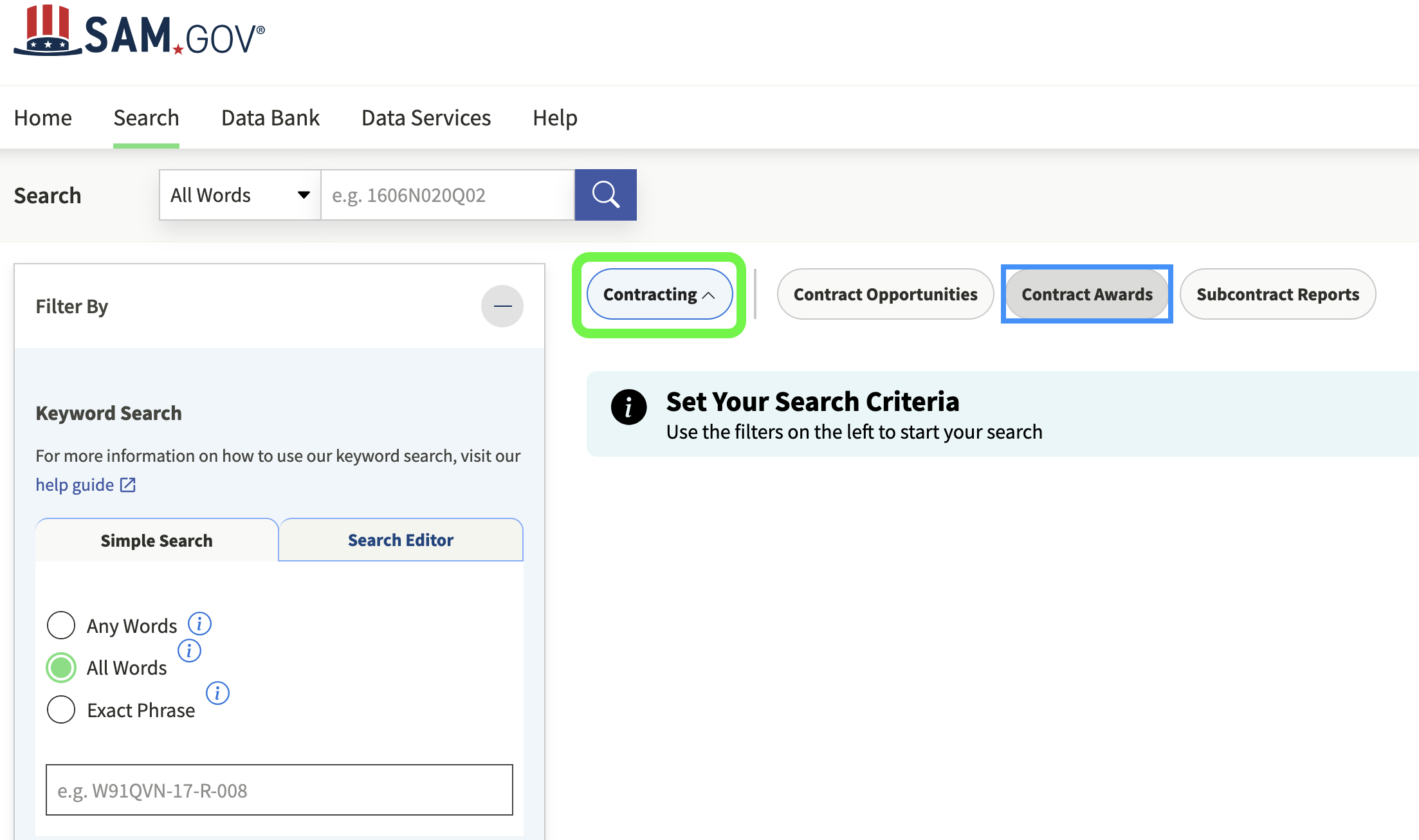
Search page on Sam.gov

We recommend selecting both "Active" and "Inactive" in the Status menu. Contracts quickly go inactive, and besides, sometimes the contracts you are most interested in are several years old. 

If you are researching a particular technology such as unmanned aerial vehicles, you might just type "unmanned" in the Simple Search bar. That will bring up every solicitation with that keyword across the federal government.

One of the most useful features is filtering by agency, while leaving the keyword search blank. This will return a running list of an agency's calls for bids and related procurement activities. It is worth checking regularly. For example, here's what CBP's looks like on a given day: 
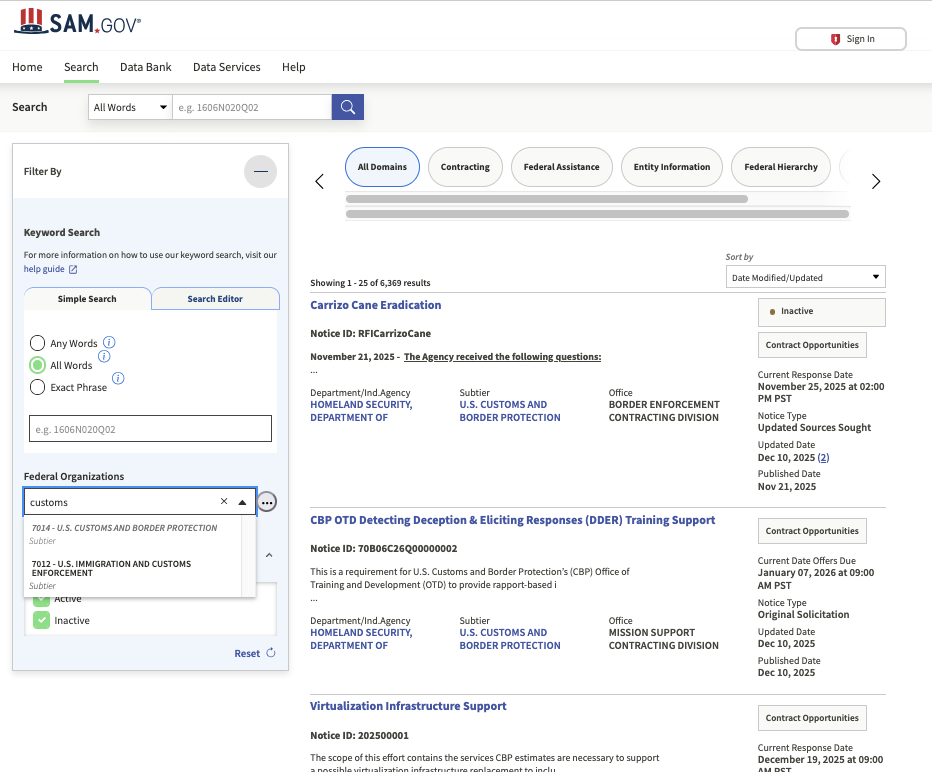
Sam.gov results for Customs and Border Patrol

If you click on an item, you should next scroll down to see if there are attachments. These tend to contain the most details. Specifically, you should look for the term "SOW," the abbreviation for "Statement of Work." For example, here are the attachments for a CBP contracting opportunity for "Cellular Covert Cameras": 
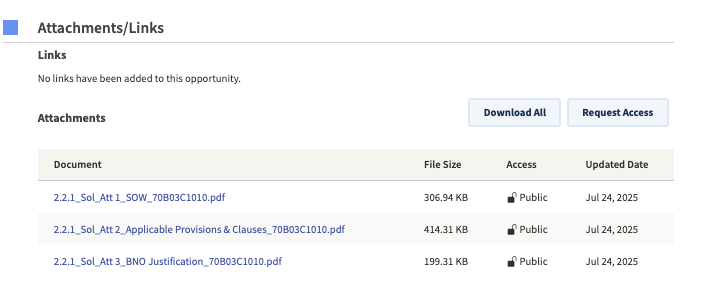
Links for attachments

The first document is the Statement of Work, which tells you the exact brand, model, and number of devices they want to acquire: 
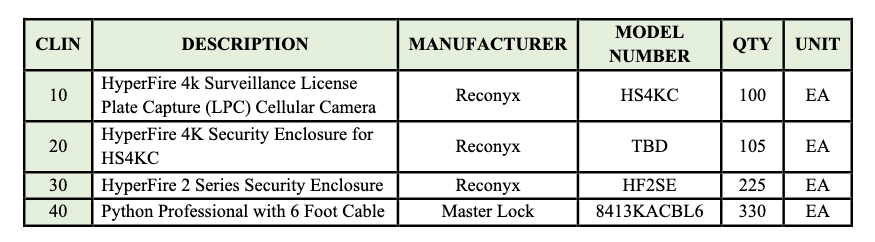
Line items for hundreds of Hyperfire cameras and related components.

The attachments also included a "BNO Justification." BNO stands for "Brand Name Only," and this document explains in even more detail why CBP wants that specific product:

Explanation of why the government wants to purchase this particular model of camera.

If you see the terms "Sole Source" in a listing, that also means that an agency has decided that only one product meets its requirements and it will not open bidding to other companies. 

In addition to contracting, many agencies announce "Industry Day" events, usually virtual, that members of the public can join. This is a unique opportunity to listen in on what contractors are being told by government purchasing officials. The presentation slides are also often later uploaded to the SAM.gov page. Occasionally, the list of attendees will also be posted, and you'll find several examples of those lists in our dataset.

3. The Government's "Superstore" - gsaadvantage.gov

Another way to investigate DHS purchasing is by browsing the catalog of items and services immediately available to them. The General Services Administration operates GSA Advantage, which it describes as "the government's central online shopping superstore." The website's search is open, allowing members of the public to view any vendors' offerings–including both products and services– easily as they would with any online marketplace. 

For example, you could search for "license plate reader" and produce a list of available products: 
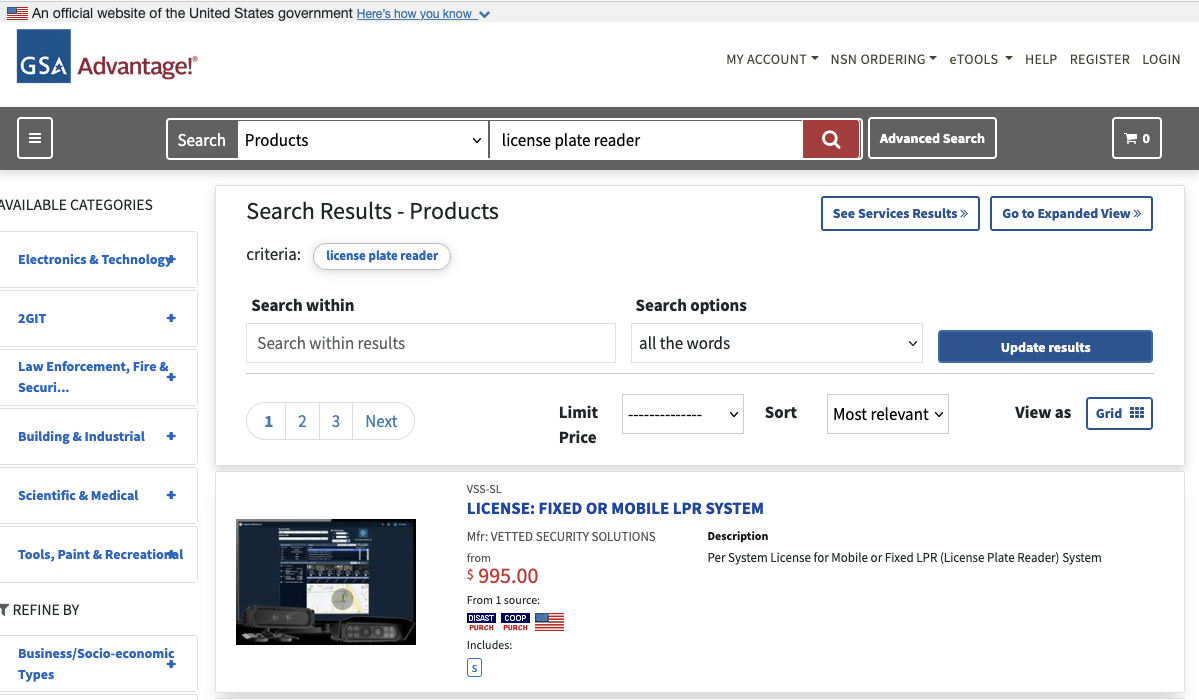
Search results that show a license plate reader for sale for $995.

If you click "Advanced Search," you can also isolate every product available from a particular manufacturer. For example, here are the results when you search for products available from Skydio, a drone manufacturer.
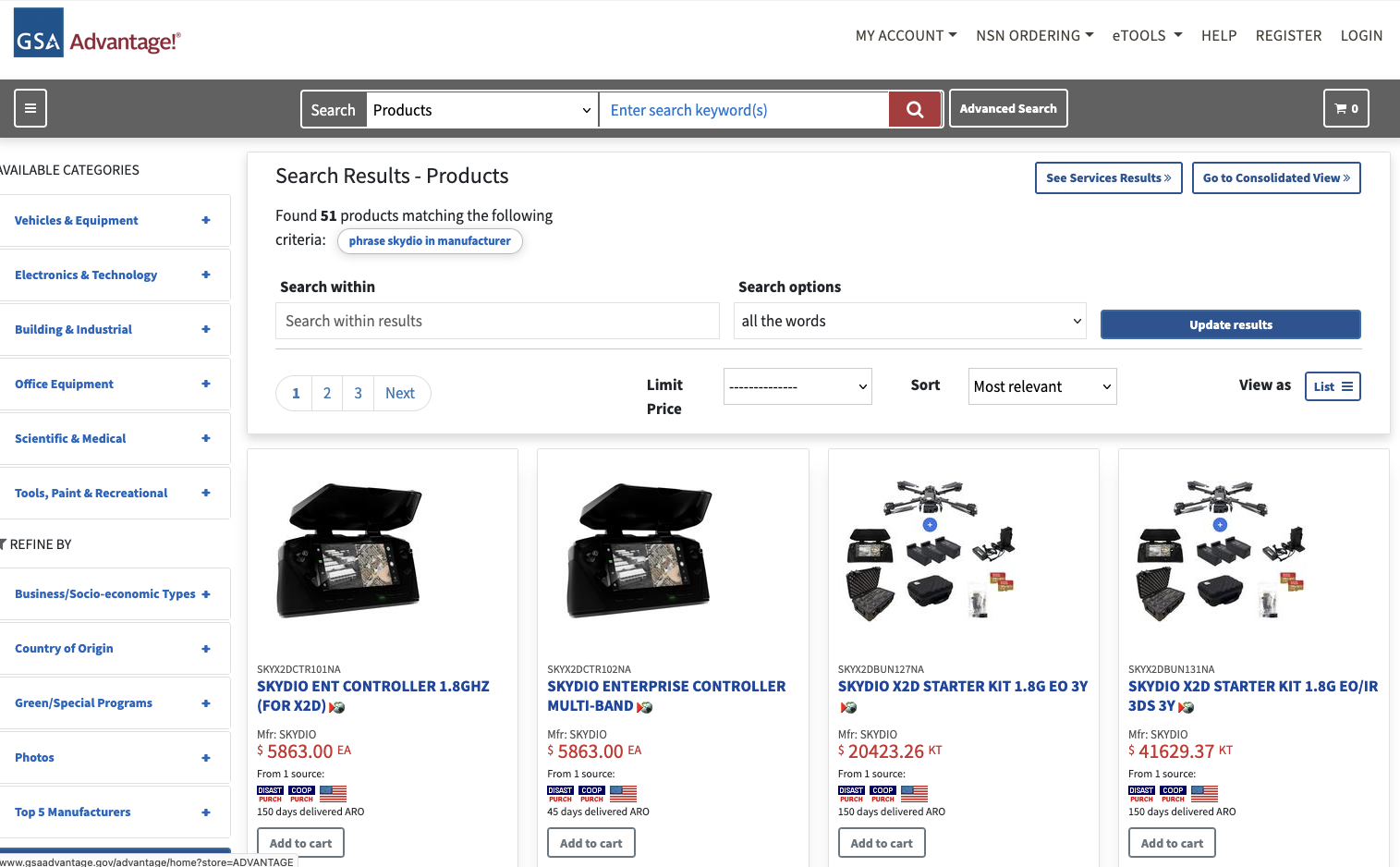
Search results for 50 Skydio drone-related products

If you switch from "Products" to "Services" you can export datasets for each company about their offerings. For example, if you search for "Palantir" you'll get results that look like this:
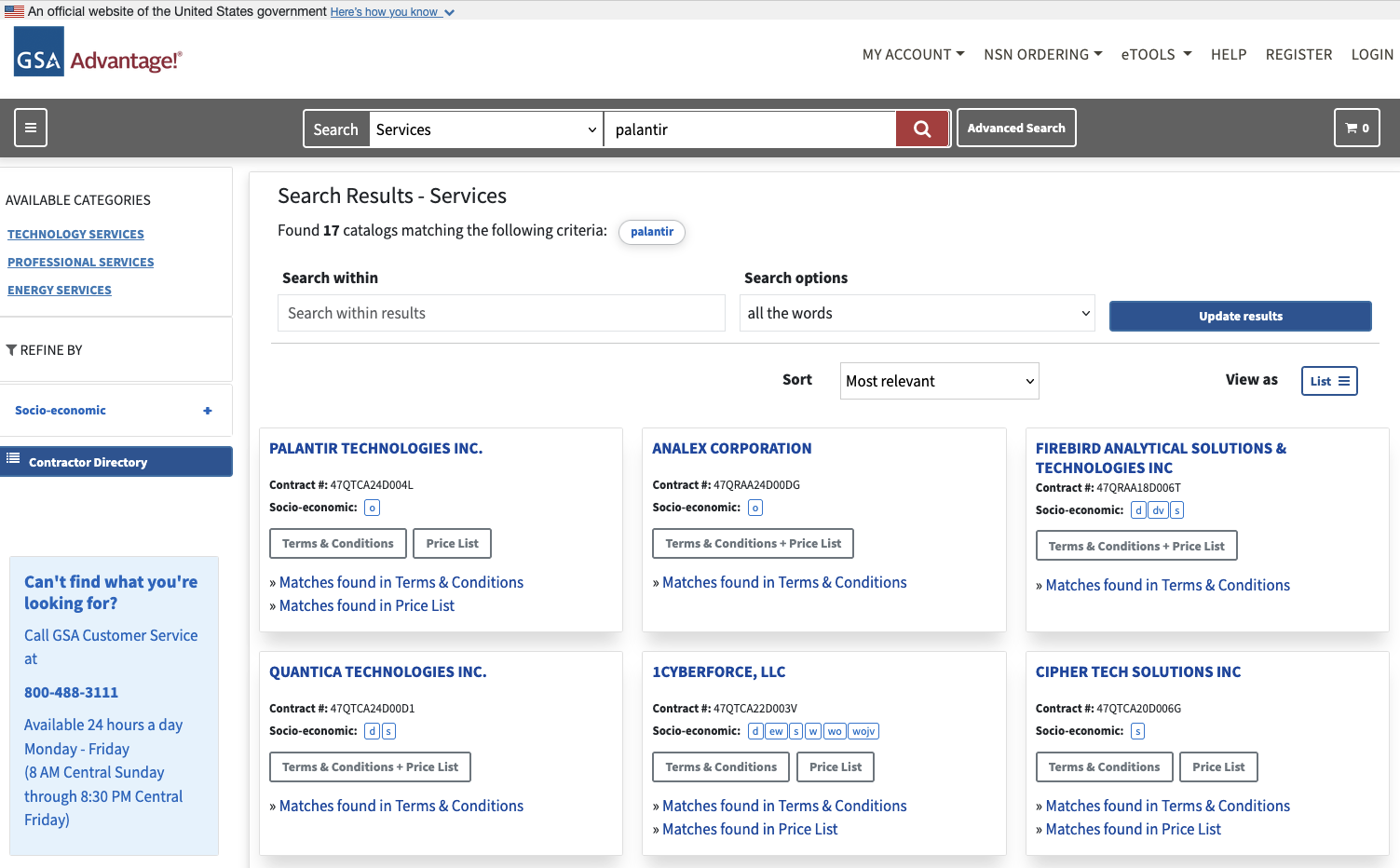
Search results with companies offering Palantir-related services.

This means all these companies are offering some sort of Palantir-related services. If you click "Matches found in Terms and Conditions," you'll download a PDF with a lot of details about what the company offers. 

For example, here's a a screengrab from Anduril's documentation

A menu of surveillance towers with prices.

If you click "Matches Found in Price List" you'll download a spreadsheet that serves as a blueprint of what the company offers, including contract personnel. Here's a snippet from Palantir's: 

A spreadsheet with prices for various Palantir services.

4. Other Resources

Daily Public Report of Covered Contract Awards - Maybe FPDS isn't enough for you and you want to know every day what contracts have been signed. Buried in the DHS website are links to a daily feed of all contracts worth $4 million or more. It's available in XML, JSON, CSV and XLSX formats. 

DHS Acquisition Planning Forecast System (APFS) - DHS operates a site for vendors to learn about upcoming contracts greater than $350,000. You can sort by agency at a granular level,  such as upcoming projects by ICE Enforcement & Removal Operations. This is one to check regularly for updates. 
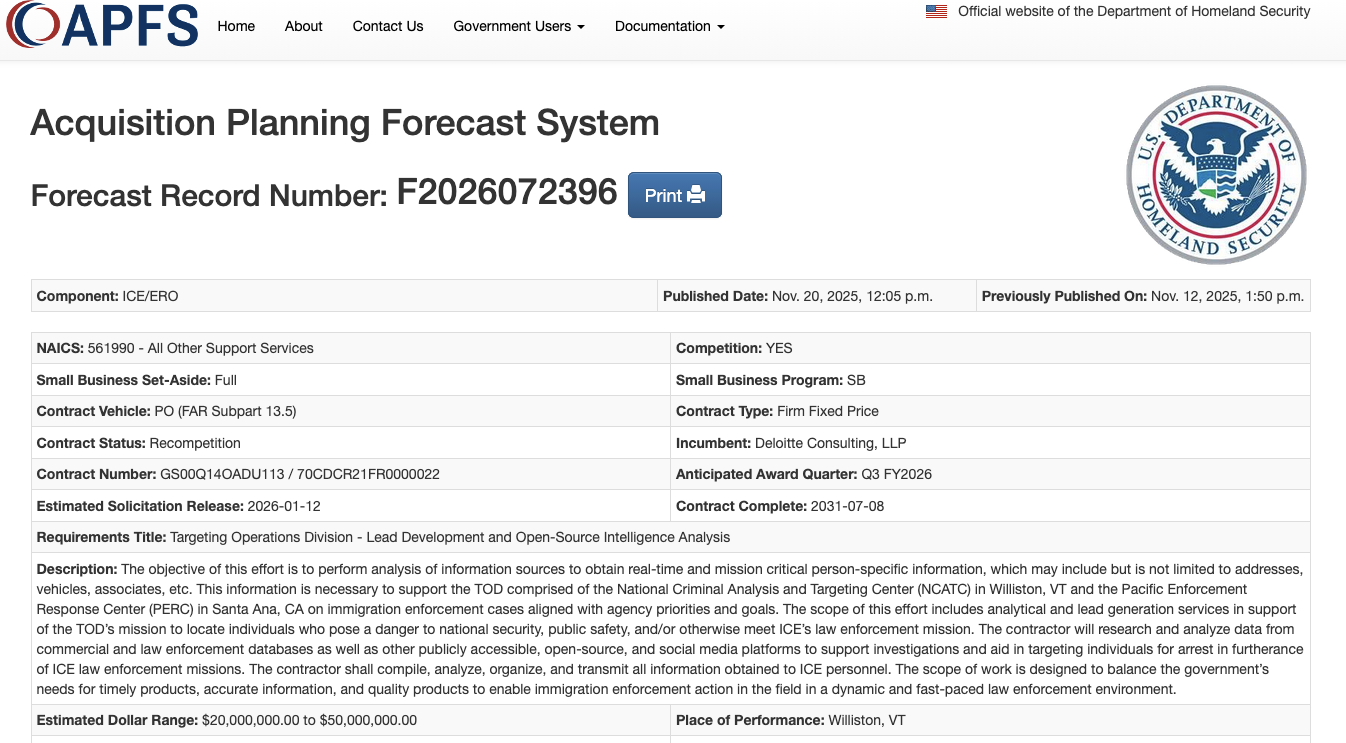
Results for a proposed contract for open source intelligence

DHS Artificial Intelligence Use Case Inventory - Many federal agencies are required to maintain datasets of "AI Use Cases." DHS has broken these out for each of its subcomponents, including ICE and CBP. Advanced users will find the spreadsheet versions of these inventory more interesting. 
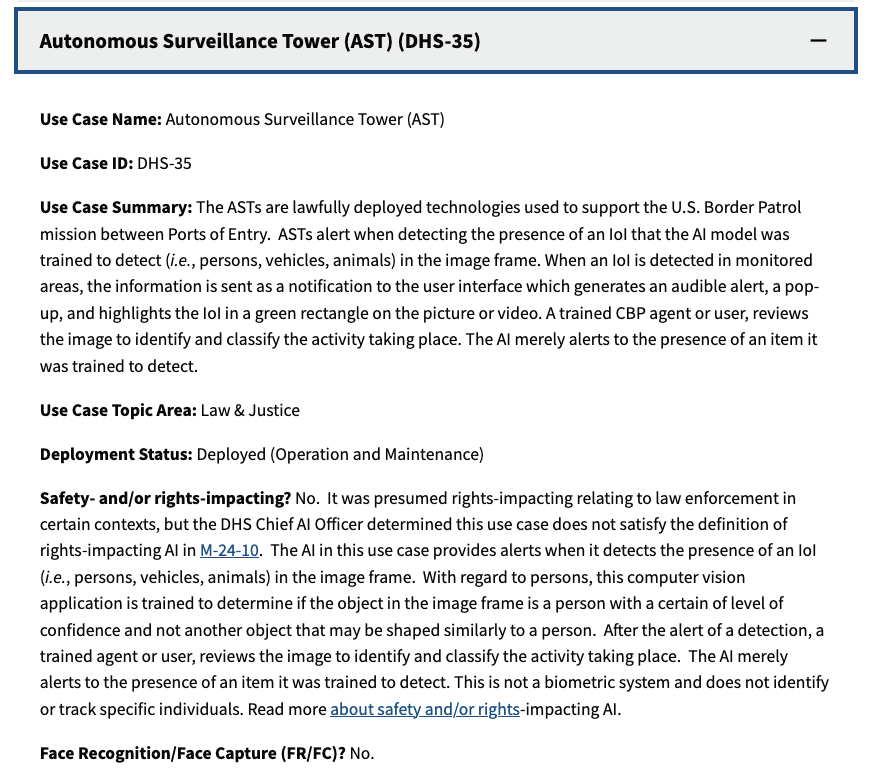
Use case summary for surveillance towers

NASA Solutions for Enterprise-Wide Procurement (SEWP) - SEWP is a way for agencies to fast track acquisition of "Information Technology, Communication and Audio Visual" products through existing contracts. The site provides an index of existing contract holders, but the somewhat buried "Provider Lookup" has a more comprehensive list of companies involved in this type of contracting, illustrating how the companies serve as passthroughs for one another. Relatedly, DHS's list of "Prime Contractors" shows which companies hold master contracts with the agency and its components. 

List of resellers of Palantir technology

TechInquiry - Techinquiry is a small non-profit that aggregates records from a wide variety of sources about tech companies, particularly those involved in government contracting. 

Tuesday, January 6th, 2026 05:14 pm

It was my turn to select a book club book, after the very good and very extensively researched literary fiction which was also very long so we didn't actually have a meeting to chat about it until well in to December.

And at said meeting, C and I got talking about Alexander Skarsgård for some reason, and she asked me if I'd seen the Murderbot TV show so I said I liked it okay but not as much as I liked the books. She said she hadn't read them, and I was like oh you really should try, I'd love to know what you think of them. And when S said she hadn't read them either, I said "Okay, that's it, I've got my book sorted, I'm gonna make you all read the first Murderbot book."

After the great but lengthy book we'd read (There are Rivers in the Sky; I really recommend it!), and over the break, I thought something quick and light would be good and the first "book," like the next few, is only about four hours long in audio form. So when someone asked if it was worth buying them all at once I explained this, and also emphasized that while I'm not the only audiobook-preferrer in our club, I'd recommend it for this because I think Kevin R. Free adds a lot to the stories -- having originally read them in audio myself, I can't imagine the books, or Murderbot, without him (I thought Mr. Skarsgård did a passable job at sounding right, for this reason).

Now we're back at work, some people like S haven't finished that first one, but C is on to Book 6 -- which I haven't even read yet, heh. I'm delighted to have introduced her to something she loves. (She agrees with me about the narrator, saying he's "great -- I do find myself saying 'stupid humans' quite a lot at the moment.") She said

It has been great company, in particular listening to it during the early hours of Christmas morning, waiting for the perfect opportunity when both of my darling children were actually asleep so I could deliver their stockings, stop pretending to be Santa, and get some sleep myself!

This image made me grin so much.

Tags:
Tuesday, January 6th, 2026 12:13 pm

I'm not dead; I've taken today & tomorrow off work and would not be surprised if I call in sick Thursday & Friday as well; I'm in less pain than I was, but I'm still pretty uncomfortable; mostly stopped coughing but my head is full of goo, which may honestly be worse. I felt marginally better yesterday, and thank goodness I took advantage of it to change my bedlinens and run the robovac, because today the prospect of taking the dirty linens down to the basement to wash them is making me quail. (ETA: 1/3 accomplished.) Naptime now.

Tuesday, January 6th, 2026 12:07 pm
As with gladness, men of old
Did the guiding star behold,
Read more... )
Tuesday, January 6th, 2026 03:29 pm

Posted by Victor Mair

Until today, I had never heard of "Dry January".  I learned about it this morning from an article in The Harvard Gazette:  "How to think about not drinking:  For starters, treat Dry January as an experiment, not a punishment, addiction specialist says."  

Remember Prohibition (in history; in the United States)?  It didn't work, did it?

Swarthmore, Pennsylvania was decidedly a dry town when I moved here half a century ago, but then a different sort of people than Quakers started to move in, until now the borough is decidedly wet.

Before Prohibition, there was teetoalism (which got mixed up with tea-drinking). and that didn't work well either.  And before that was alcohol abstinence, and that was unsuccessful too.  What with alcoholic beverages flooding our grocery stores, I don't think there's a ghost of a chance that Dry January will have a significant impact on alcohol consumption in the United States.

One thing that puzzles me is why anti-smoking legislation has been so successful.  Which is more harmful to the human body and human society — booze or tobacco?

Apparently, Dry January goes back at least to 2008 (source).  This year it coincides with my personal New Year's resolution to cut out the daily dose of pastry, ice cream, and dollop of whipped cream to which I have been addicted for decades, and for which I now have proof positive of its ill effects on my health.  This is one resolution that I am going to keep in perpetuity.


Selected reading

Tuesday, January 6th, 2026 02:39 pm

AO3 Logo with the words AO3 Update

In 2020, we gave you some insight into our traffic numbers, focusing on the impact that global lockdowns had on our user base. Five years later, we have not only sustained that rise in users but also continued to grow steadily, so we thought we’d show you an update!

Comments in 2025

A line graph showing monthly comments on AO3 in 2020 and 2025 with the line for 2025 consistently one to two million higher than 2020.

Image 1: Line graph of monthly comments on AO3 in 2020 versus 2025. Both line graphs share small dips in February, June, and September; and peaks in July, August, and October; before sharply trending upward in December. 2020 sees an additional sharp increase in April, while 2025 shows a more typical slow rise throughout the year.

In our previous post, we observed a common pattern of slight dips in user activity in June and September. This pattern still holds true: Our users left 84,278 fewer comments in June than in May, before coming back en masse in July and August. We see a significant drop in September before cresting a suspiciously Kinktober-shaped peak in October. November sees the bustle die down one more time, before we reach record highs—crossing 5 million comments for the first time—by way of our typical end-of-year holiday increase in December.

The raw data for this graph can be found in this spreadsheet: Comments 2020/2025 (Google Sheets).

Daily page views

A line graph of daily page views from April 17th to December 31st 2025 generally trending upwards with many peaks and troughs.

Image 2: Line graph showing AO3’s daily page views (in millions) starting in mid-April and ending on December 31st. Smaller spikes show higher activity on weekends than weekdays. There is one big spike to 141 million on June 1st, and two big dips to 73.7 and 72 million respectively on July 3rd and September 29th. The trend line rises slowly but steadily, crossing 110 million daily page views in mid-October.

Site traffic tends to slowly increase throughout the year with a noticeable jump in December, and we then carry that forward into the new year. Our first anomaly happens around June 1st, with several days of incredibly high page views. After consulting with our Systems volunteers, we marked this off as likely being due to a large influx of bot traffic.

On July 3rd and 4th, we ran out of rows in the database table that stores bookmarks, so we had to move them to a larger table that can hold them all! This made it so you can once again add your own bookmarks to the 647 million we already had before then. The recovery after this outage is a little higher than normal, possibly due to an influx of users downloading works to tide themselves over any future outages.

On September 29th, we had to take some planned downtime to implement an update to collections—Collection owners can now use up to ten tags of any type to describe their collection, making it easier to find collections featuring the fandoms, relationships, tropes, and other topics you enjoy.

The raw data for this graph can be found in this spreadsheet: Daily page views 2025 (Google Sheets).

Site traffic throughout a typical week

A line graph showing daily page views in August 2025

Image 3: Line graph of daily page views. A subsection of the above graph, more clearly showing the ebb and flow of traffic on the archive throughout the calendar week. There are five clear peaks on every weekend with the apex on Sunday. Thursday and Friday are where traffic dips to its lowest.

If we zoom in a little, we can clearly see that weekends are most of our users’ favourite time to engage with fanworks. Some may wonder about the peaks seeming to run over into Monday—our systems run in UTC and much of our traffic comes from later timezones. More North and South Americans reading late at night on Saturday and Sunday equals peaks on Sunday and Monday!

The raw data for this graph can be found in this spreadsheet: Daily page views August 2025 (Google Sheets).

New Year’s Eve by the minute

A line graph of server requests on New Year’s Eve across the globe

Image 4: Line graph of requests received by our servers between 9:00 UTC on December 31st 2025 and 9:00 UTC on January 1st 2026. Requests start to rise from ~550K at 12:00 UTC, peaking at nearly 800K at 17:30 UTC before slowly decreasing back down to ~650K. Sharp, sudden drops are noticeable at 16:00 UTC, 23:00 UTC, and 5:00 UTC, with smaller drops at 0:00 UTC and 6:00 UTC.

The delayed effect described in the previous section is especially noticeable on New Year’s Eve. We receive sudden, hourly drops in requests to our servers as users in different timezones pause their reading to ring in the new year. At 16:00 UTC, 47 thousand users in UTC+8 promptly went offline before coming back in force half an hour later, giving us our first noticeable drop. The yearline swept across the globe with minor dips on each hour, before UTC+1 dropped us by a whole 50 thousand requests and UTC followed with just 43 thousand requests. By far the most severe dip occurs when UTC-5 entered 2026, with over 80 thousand fewer requests—compared to UTC-8, which only dropped us by 30 thousand requests.

The raw data for this graph can be found in this spreadsheet: New Year’s Eve by the minute (Google Sheets).

Site traffic over the years

A bar chart showing the past 13 years of weekly traffic on AO3

Image 5: Bar chart showing weekly traffic during the last week of November on AO3 from 2012 to 2025. Large jumps are noticeable between 2019 and 2020, 2022 and 2023, and 2024 and 2025.

To round things off, let’s have a look back through time!

We had a big jump in users this year—November 2025 saw over 146.6 million weekly page views more than the previous November. At first glance this is significantly higher than the 129 million increase we experienced from 2019 to 2020, but this is only 22% growth over the previous year as opposed to 52% because our baseline looks completely different.

We are excited to see where 2026 takes us, and it looks like we're already starting off strong! In the first week of the year we amassed a record high of 879 million page views, a significant jump up from 816 million the week before and averaging out to ~125 million page views a day. We look forward to breaking more records with you.

The raw data for this graph can be found in this spreadsheet: Weekly Traffic 2012-2025 (Google Sheets).


The Organization for Transformative Works is the non-profit parent organization of multiple projects including Archive of Our Own, Fanlore, Open Doors, OTW Legal Advocacy, and Transformative Works and Cultures. We are a fan-run, donor-supported organization staffed by volunteers. Find out more about us on our website.

Tuesday, January 6th, 2026 09:14 am
I updated my sticky post with: PSA: if you get an email out of the blue that is supposedly from me, offering to help you with marketing or other publisher services, or asking for money, it is not me, it is a scammer. Also, if you see me on Facebook or Threads or XTwitter, that's not me either.

This is a very common scam now, one of the many scams aimed at aspiring and new writers.


***


I'm still sick, ugh


***


Nice article on Queen Demon on the Daily KOS:

https://www.dailykos.com/stories/2026/1/5/2361356/-The-Language-of-the-Night-Martha-Wells-takes-on-colonization

One of Wells’ most compelling gifts as a writer is the way she interrogates trauma, and trauma is very much in evidence in her recent works, especially in both Murderbot and The Rising World. Where the Murderbot stories form an enslavement narrative as personal journey and healing, the Rising World series applies a wider cultural lens to trauma and loss.

Kai has seen his world ripped apart twice: the way to the underneath, the world of his birth, is shut off; the world of his above existence, the world of the Saredi, is also gone, both of them murdered by the Hierarchs. (You could argue that the third traumatizing loss-of-world is losing Bashasa, but that lies in the gap between past and present narratives.) In the past narrative, a vanquished Kai himself is imprisoned in the Summer Halls until Bashasa frees him and he joins the ad hoc rebellion.
Tuesday, January 6th, 2026 02:00 pm

Posted by Jen

Tabitha G. ordered a Mario cake for her five-year-old's birthday party.

You know Mario, right?

Yeah. This guy.


And that's when things went horribly, hilariously wrong:

"Did-a somebody call-a a plumber?" [eyebrow waggle]


No, no, take a moment. Soak it alllll in. The leather biker hat. The earring. The collar. The nipple and gratuitous chest hair. Oh yeah, and the fact that his lower half is on backwards. (Why? WHY??)

How did this happen? Why does this art even exist? And seriously, what the heck is going on with that front butt?

The world may never know.

We DO know the bakery replaced The Village Mario here with a free Spongebob cake, though.

So Tabitha, just one question:

Was SpongeBob wearing a gimp suit? :D

*****

P.S. Have you played with Perler Beads? Those are the plastic pellets you iron together to make coasters or ornaments or hair bows or whatnot - and there's a Super Mario set!

Perler Bucket Activity Kit


This set comes with the pegboard, patterns, ironing sheet, and of course all the beads you need to make at least 11 different designs. Here's a pic from the reviews, aren't they great?

This is a perfect craft for kids AND adults. Hit the link up there to see several more design kits, including Star Wars and Harry Potter.

******

And from my other blog, Epbot:

Tuesday, January 6th, 2026 02:32 pm

Posted by choux

In 2020, we gave you some insight into our traffic numbers, focusing on the impact that global lockdowns had on our user base. Five years later, we have not only sustained that rise in users but also continued to grow steadily, so we thought we’d show you an update!

Comments in 2025

A line graph showing monthly comments on AO3 in 2020 and 2025 with the line for 2025 consistently one to two million higher than 2020.

Image 1: Line graph of monthly comments on AO3 in 2020 versus 2025. Both line graphs share small dips in February, June, and September; and peaks in July, August, and October; before sharply trending upward in December. 2020 sees an additional sharp increase in April, while 2025 shows a more typical slow rise throughout the year.

In our previous post, we observed a common pattern of slight dips in user activity in June and September. This pattern still holds true: Our users left 84,278 fewer comments in June than in May, before coming back en masse in July and August. We see a significant drop in September before cresting a suspiciously Kinktober-shaped peak in October. November sees the bustle die down one more time, before we reach record highs—crossing 5 million comments for the first time—by way of our typical end-of-year holiday increase in December.

The raw data for this graph can be found in this spreadsheet: Comments 2020/2025 (Google Sheets).

Daily page views

A line graph of daily page views from April 17th to December 31st 2025 generally trending upwards with many peaks and troughs.

Image 2: Line graph showing AO3’s daily page views (in millions) starting in mid-April and ending on December 31st. Smaller spikes show higher activity on weekends than weekdays. There is one big spike to 141 million on June 1st, and two big dips to 73.7 and 72 million respectively on July 3rd and September 29th. The trend line rises slowly but steadily, crossing 110 million daily page views in mid-October.

Site traffic tends to slowly increase throughout the year with a noticeable jump in December, and we then carry that forward into the new year. Our first anomaly happens around June 1st, with several days of incredibly high page views. After consulting with our Systems volunteers, we marked this off as likely being due to a large influx of bot traffic.

On July 3rd and 4th, we ran out of rows in the database table that stores bookmarks, so we had to move them to a larger table that can hold them all! This made it so you can once again add your own bookmarks to the 647 million we already had before then. The recovery after this outage is a little higher than normal, possibly due to an influx of users downloading works to tide themselves over any future outages.

On September 29th, we had to take some planned downtime to implement an update to collections—Collection owners can now use up to ten tags of any type to describe their collection, making it easier to find collections featuring the fandoms, relationships, tropes, and other topics you enjoy.

The raw data for this graph can be found in this spreadsheet: Daily page views 2025 (Google Sheets).

Site traffic throughout a typical week

A line graph showing daily page views in August 2025

Image 3: Line graph of daily page views. A subsection of the above graph, more clearly showing the ebb and flow of traffic on the archive throughout the calendar week. There are five clear peaks on every weekend with the apex on Sunday. Thursday and Friday are where traffic dips to its lowest.

If we zoom in a little, we can clearly see that weekends are most of our users’ favourite time to engage with fanworks. Some may wonder about the peaks seeming to run over into Monday—our systems run in UTC and much of our traffic comes from later timezones. More North and South Americans reading late at night on Saturday and Sunday equals peaks on Sunday and Monday!

The raw data for this graph can be found in this spreadsheet: Daily page views August 2025 (Google Sheets).

New Year’s Eve by the minute

A line graph of server requests on New Year’s Eve across the globe

Image 4: Line graph of requests received by our servers between 9:00 UTC on December 31st 2025 and 9:00 UTC on January 1st 2026. Requests start to rise from ~550K at 12:00 UTC, peaking at nearly 800K at 17:30 UTC before slowly decreasing back down to ~650K. Sharp, sudden drops are noticeable at 16:00 UTC, 23:00 UTC, and 5:00 UTC, with smaller drops at 0:00 UTC and 6:00 UTC.

The delayed effect described in the previous section is especially noticeable on New Year’s Eve. We receive sudden, hourly drops in requests to our servers as users in different timezones pause their reading to ring in the new year. At 16:00 UTC, 47 thousand users in UTC+8 promptly went offline before coming back in force half an hour later, giving us our first noticeable drop. The yearline swept across the globe with minor dips on each hour, before UTC+1 dropped us by a whole 50 thousand requests and UTC followed with just 43 thousand requests. By far the most severe dip occurs when UTC-5 entered 2026, with over 80 thousand fewer requests—compared to UTC-8, which only dropped us by 30 thousand requests.

The raw data for this graph can be found in this spreadsheet: New Year’s Eve by the minute (Google Sheets).

Site traffic over the years

A bar chart showing the past 13 years of weekly traffic on AO3

Image 5: Bar chart showing weekly traffic during the last week of November on AO3 from 2012 to 2025. Large jumps are noticeable between 2019 and 2020, 2022 and 2023, and 2024 and 2025.

To round things off, let’s have a look back through time!

We had a big jump in users this year—November 2025 saw over 146.6 million weekly page views more than the previous November. At first glance this is significantly higher than the 129 million increase we experienced from 2019 to 2020, but this is only 22% growth over the previous year as opposed to 52% because our baseline looks completely different.

We are excited to see where 2026 takes us, and it looks like we’re already starting off strong! In the first week of the year we amassed a record high of 879 million page views, a significant jump up from 816 million the week before and averaging out to ~125 million page views a day. We look forward to breaking more records with you.

The raw data for this graph can be found in this spreadsheet: Weekly Traffic 2012-2025 (Google Sheets).


The Organization for Transformative Works is the non-profit parent organization of multiple projects including Archive of Our Own, Fanlore, Open Doors, OTW Legal Advocacy, and Transformative Works and Cultures. We are a fan-run, donor-supported organization staffed by volunteers. Find out more about us on our website.

Tuesday, January 6th, 2026 06:02 am
DSC_0545.jpg
Yesterday's: Winter Tree.

Skye is doing better. I've started to feed her Fancy Feast pate cat food with a generous dollop of water mixed in and she eats it all. She looks better. But not exactly "well". I'm thinking next week I will take her in for the x-ray.

When I was outside doing chicken chores this morning I noticed there was frost on the rubber covered lids of both nest boxes:

IMG_20260106_080003562[1].jpg

IMG_20260106_080643574_HDR.jpg
Tuesday, January 6th, 2026 09:13 am
Doubtful as it may be under present conditions to find encouragement in anything of military origin unless it's the USS Princeton in 1844, about twenty-seven seconds into the two minutes' patriotism of Warship Week Appeal (1942) I cracked up.

Two hundred feet exactly of no-credits 35 mm, the object in question is a trailer produced for the Ministry of Information, essentially the same concept as the film tags of WWI: a micro-dose of propaganda appended to a newsreel as part of a larger campaign, in this case a sort of public information skit in which it is supposed that Noël Coward on the Denham sets of In Which We Serve (1942) is approached by Leslie Howard, slouching characteristically on with his hands in his pockets and his scarf twisted carelessly label-out, anxious to discuss a problem of National Savings. "How do you think we can make an appeal so it won't quite seem like an appeal?" With limited screen time to realize their meta conceit, the two actor-directors get briskly down to explaining the mechanics of the scheme to the British public with the shot-reverse-shot patter of a double act on the halls, but the trailer has already dropped its most memorable moment ahead of all its instructions and slogans, even the brief time it rhymes. Diffident as one end of his spectrum of nerd heroes, Howard apologizes for the interruption, excuses it with its relevance to naval business, and trails off with the usual form of words, "I'm sure you won't mind—" to which Coward responds smoothly, "I'm delighted to see you. And I know perfectly well—as we rehearsed it so carefully—that you've come to interview me about Warships Week." He doesn't even bother to hold for a laugh as Leslie snorts around his unlit cigarette. It doesn't all feel like a bit. The interjection may or may not have been scripted, but Coward's delivery is lethally demure and his scene partner's reaction looks genuine; for one, it's much less well-timed or dignified than the smile he uses to support a later, slightly obligatory joke about the income tax, which makes it that much more endearing. It's funny to me for a slant, secondhand reason, too, that has nothing to do with the long friendship between the two men or further proof of Noël's deadpan for the ages: a dancer with whom my mother once worked had been part of the company of Howard's 1936 Hamlet and like all the other small parts, whenever her back was to the audience and the Hollywood star was stuck facing the footlights, she tried to corpse him. One night she finally succeeded. Consequently and disproportionately, watching him need the length of a cigarette-lighting to get his face back, I thought of her story which I hadn't in years and may have laughed harder than Leslie Howard deserved. If it's any consolation to him, the way his eyes close right up like a cat's is beautiful, middle-aged and underslept. It promotes the illusion that a real person might say a phrase like "in these grim days when we've got our backs to the wall" outside of an address to the nation.

Not much consolation to the MOI, Warship Week Appeal accomplishes its goal in that while it doesn't mention for posterity that a community would adopt the ship it funded, the general idea of the dearth of "ships—more ships and still more ships" and the communal need to pay down for them as efficiently as possible comes through emphatically. It's so much more straightforward, in fact, than I associate with either of its differently masked actors, I'd love to know who wrote it, but the only other information immediately available is that the "Ronnie" whom Coward is conferring with when Howard courteously butts in is Ronald Neame. Given the production dates of their respective pictures, it's not difficult to pretend that Howard just popped over from the next sound stage where he was still shooting The First of the Few (1942), although he is clearly in star rather than director mode because even if he's in working clothes, he is conspicuously minus his glasses. What can I tell you? I got it from the Imperial War Museum and for two minutes and thirteen seconds it cheered me up. Lots of things to look at these days could do much, much worse. This interview brought to you by my appealing backers at Patreon.
Tags:
Tuesday, January 6th, 2026 08:52 am


What was the purpose behind raising an unconventional child like Thorn?

Cuckoo’s Egg by C J Cherryh
Tuesday, January 6th, 2026 12:36 pm

Posted by Mark Liberman

Annie Joy Williams, "The Last Days of the Southern Drawl", The Atlantic 1/4/2026:

By the end of my life, there may be no one left who speaks like my father outside the hollers and the one-horse towns.

On Sundays after church, my family would pile into our crank-window GMC truck and head to Kentucky Fried Chicken. “Can I get me some of them tater wedges?” my father would say into the speaker, while my sisters and I giggled in the back seat. My dad has always had a southern accent: His words fall out of his mouth the way molasses would sound if it could speak, thick and slow. But his “KFC voice,” as my sisters and I call it, is country. It’s watered-down on work calls and during debates with his West Coast relatives. But it comes out around fellow cattle farmers and old friends from Kentucky, where he grew up.

My mother’s accent isn’t quite as strong. She’s a therapist, and she can hide it when she speaks with her patients and calls in prescriptions. But you can always hear it in her church-pew greetings, and when she says goodnight: “See you in the a.m., Lawd willin’.”

I was always clear on one fact: I wasn’t going to have a southern accent when I grew up. I was raised in Murfreesboro, Tennessee, near Nashville, where the accents grow stronger with each mile you travel from the city. I watched people snicker at the redneck characters on television who always seemed to play the town idiot. I knew what the accent was supposed to convey: sweet but simpleminded. When I was 15 and my family went to New York for the first time, the bellhop at our hotel laughed when my mom and I spoke; he said he’d never met cowgirls before. That was when I decided: No one was going to know I was from the South from my voice alone.

The article sketches a conversation with Margaret Renwick, links to two of her studies ("Boomer Peak or Gen X Cliff? From SVS to LBMS in Georgia English" and "Demographic Change, Migration, and the African American Vowel System in Georgia"), and lays out some of the reasons for homogenization of local varieties, including migration and ethnocentric prejudice.

And then there's a series of (positively-evaluated) discussions about code-switching, offering hope that the future of American speech may be less homogeneous than the title suggests.

The whole article is well worth reading.

It doesn't discuss the process by which new varieties emerge and spread, but that would be a distraction from its nostalgic tone. Still, it's worth noting that a similar set of issues form the background of George Bernard Shaw's 1916 play Pygmalion, and in fact have been around, in one form or another, since the origins of spoken language. It's true that the internet and social media are a new source of change, just as in the past there were effects of agriculture, writing, empires, universal education, and broadcasting. But it's been hundreds of years since (for example) the Romance dialect continuum coalesced into a few national languages, with the associated gradual loss of tens of thousands of local varieties.

And there's plenty of evidence that American regional varieties are diverging rather than converging — see Bill Labov's 2012 book Dialect Diversity in America, whose blurb says

The sociolinguist William Labov has worked for decades on change in progress in American dialects and on African American Vernacular English (AAVE). In Dialect Diversity in America, Labov examines the diversity among American dialects and presents the counterintuitive finding that geographically localized dialects of North American English are increasingly diverging from one another over time.

Contrary to the general expectation that mass culture would diminish regional differences, the dialects of Los Angeles, Dallas, Chicago, Birmingham, Buffalo, Philadelphia, and New York are now more different from each other than they were a hundred years ago. Equally significant is Labov's finding that AAVE does not map with the geography and timing of changes in other dialects. The home dialect of most African American speakers has developed a grammar that is more and more different from that of the white mainstream dialects in the major cities studied and yet highly homogeneous throughout the United States.

Labov describes the political forces that drive these ongoing changes, as well as the political consequences in public debate. The author also considers the recent geographical reversal of political parties in the Blue States and the Red States and the parallels between dialect differences and the results of recent presidential elections. Finally, in attempting to account for the history and geography of linguistic change among whites, Labov highlights fascinating correlations between patterns of linguistic divergence and the politics of race and slavery, going back to the antebellum United States. Complemented by an online collection of audio files that illustrate key dialectical nuances, Dialect Diversity in America offers an unparalleled sociolinguistic study from a preeminent scholar in the field.

Increasing divergence doesn't imply stasis — on the contrary, obviously. But still…

Update — Williams' description of her father's speech ("His words fall out of his mouth the way molasses would sound if it could speak, thick and slow") is evocative, but may not be empirically accurate. See "Regional speech rates", 10/13/2007.

And for a striking example of inter-ethnic phonetic prejudice, see Michael Lewis (who's from New Orleans) ridiculing the pronunciation of a lawyer from southern Indiana, discussed in "Lazy mouths vs. lazy minds", 11/26/2003.

Update #2 — For those who aren't familiar with the way people from rural Tennessee speak, here's a clip of Trae Crowder:


Tuesday, January 6th, 2026 04:25 am
Back in 2021, I reviewed here the memoirs of every moonshot-era astronaut who'd written one. Soon afterwards, another one came out that I didn't find out about until recently. So I'm adding it.

Fred Haise (Apollo 13, STS-ALT-9, 11, 12, 14, 16), Never Panic Early: An Apollo 13 Astronaut's Journey, with Bill Moore (Smithsonian Books, 2022)
Fairly brief as these memoirs go. Haise says that at the time he was wrapped up in the nitty-gritty details of his job, and that's what this book is like too. There are occasional piercing insights into astronaut personalities (Jim Lovell under the stress of Apollo 13 started to act like the martinet Frank Borman) or of what experiences felt like to Haise, and excursions into externalities like what his living situation was like (e.g. napping in the simulator because it was too much trouble to take the time to go back to his hotel room), but no emotional reactions to problems - that's the point of his title, which he takes as a frequently-repeated personal motto - and though he notes the births of his children, there's virtually nothing about his life with them or his wife.
That's because he was so busy working he didn't have one, and that, he says, is the reason he eventually got divorced: no connection with his family. But Haise's workaholic attitude has its virtues in this book. Like other astronauts, he found that flying came naturally to him when he first undertook it, but unlike most he goes into detail about what learning to do it actually consisted of. His detail on the Apollo 13 mission is a useful supplement to the movie version, but he only mentions the movie once briefly and makes no direct comparisons or corrections.
After Apollo 13, Haise plunges into equal detail on the subsequent publicity junkets before going back to work on flight training, including flying many of the space shuttle's approach and landing tests, though he retired from NASA before any actual shuttle missions flew, then going to work as an administrator for the aerospace firm that he knew well because they'd built the lunar module. He also recounts the detail of his gruesome medical recovery from a plane crash.
But the hasty tone and lack of some detail remains a flaw. Haise recounts being told, after serving as backup on Apollo 8, that he'd be backup again for Apollo 11, without mentioning that he was bumped from the prime crew (the usual followup) or why - he was pre-empted by the more senior Mike Collins, who returned to flight status following surgery (Collins tells that story apologetically in his book).

previous posts on astronaut memoirs
introduction
Mercury Seven
Next Nine
Group Three
Original Nineteen
Tuesday, January 6th, 2026 11:00 am

Posted by J.R. Dawson

I met you on the train. The first time it happened, I didn’t know what to do or what to say to you. I just saw your patches on your backpack. And they were from the same TV show that mine were from. So I spent the whole time staring. You left at the next stop. I rewound […]

The post I Met You on the Train appeared first on Uncanny Magazine.

Tuesday, January 6th, 2026 11:00 am

Posted by Caroline M. Yoachim

Christopher Caldwell is a queer, Black American who lives and works in Glasgow, Scotland. He is a recipient of the Octavia E. Butler Memorial Scholarship and an alumnus of Clarion West. His work has appeared in publications such as Apex Magazine, Strange Horizons, and Fiyah Literary Magazine, as well as the anthologies New Suns 2, Trouble […]

The post Interview: Christopher Caldwell appeared first on Uncanny Magazine.

Tuesday, January 6th, 2026 11:00 am

Posted by A. T. Greenblatt

It’s Sunday night, which means it’s our Friday night, which means the Doorkeepers go out and get absolutely blasted. It’s not as messy as it sounds. We’re polite drunks; we make a point of it actually, because we deal with our fair share of liquid-courage-gone-south on the job. And we know what we don’t want […]

The post The Doorkeepers appeared first on Uncanny Magazine.